

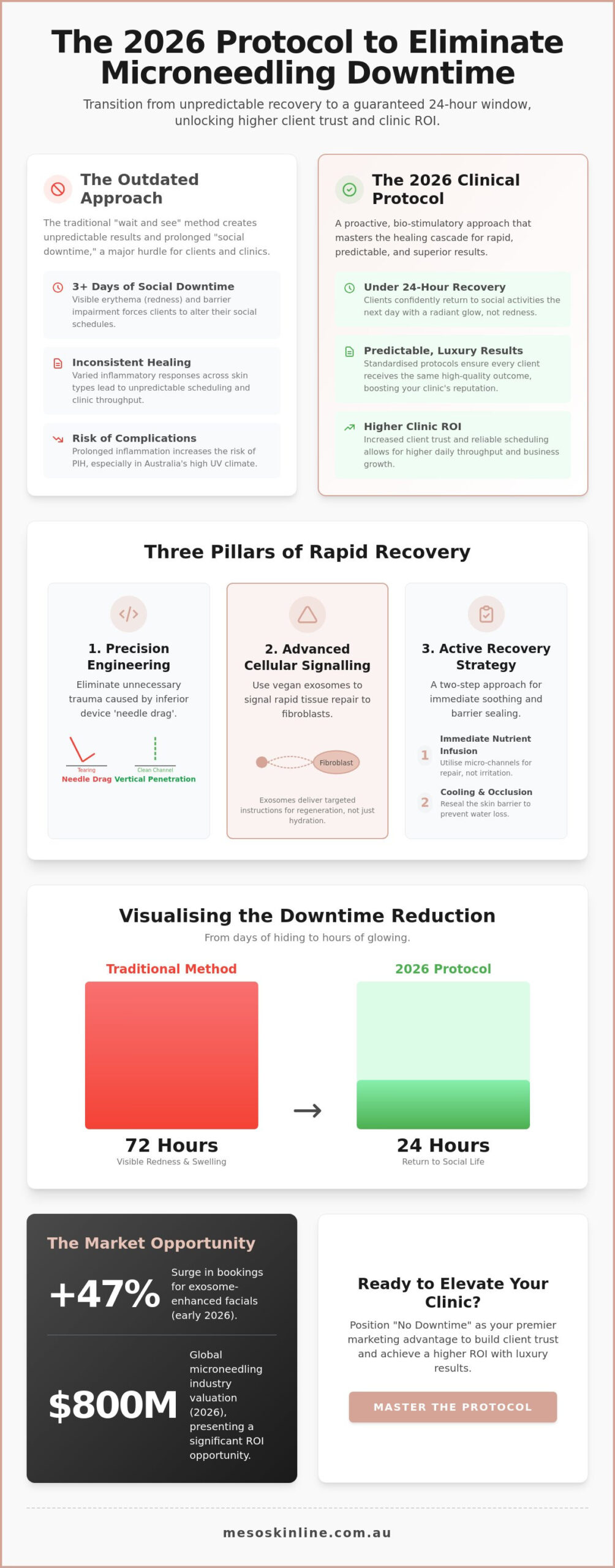
Did you know that bookings for exosome-enhanced facials surged by 47% in early 2026? This shift isn’t just a passing trend; it’s a direct response to the aesthetic industry’s most persistent hurdle: the dreaded “social downtime.” You’ve likely seen it in your own clinic where clients crave transformation but hesitate the moment they hear about three days of post-treatment redness. It’s frustrating when inconsistent healing across different skin types makes your schedule unpredictable and limits your clinic’s daily throughput.
We’re here to change that narrative by focusing on reducing client downtime after microneedling through a sophisticated blend of precision technology and advanced cellular signalling. By mastering these 2026 clinical protocols, you can transition from prolonged inflammatory responses to predictable 24-hour recovery windows. This guide explores the impact of the 2025 FDA safety communications regarding RF devices, the integration of vegan exosomes to accelerate repair, and how the global microneedling industry’s $800 million valuation in 2026 offers a significant ROI opportunity for your practice. Discover how to deliver the “luxury results” your clients expect while securing the business growth you deserve.
Key Takeaways
- Master the biological wound healing cascade to accurately predict recovery windows and manage visible erythema for every skin type.
- Understand how precision engineering and vertical needle penetration eliminate epidermal tearing and unnecessary trauma caused by inferior device “needle drag.”
- Discover the regenerative power of vegan exosomes for reducing client downtime after microneedling by signalling rapid tissue repair to fibroblasts.
- Implement the 2026 clinical protocol: a two-step approach involving immediate nutrient infusion followed by advanced cooling and occlusion strategies.
- Position “No Downtime” as your clinic’s premier marketing advantage to build client trust and achieve a higher ROI through luxury results.
Understanding Microneedling Downtime: Biology and Clinical Expectations
Clinical downtime shouldn’t be a guessing game. In professional aesthetics, we define this window as the period of visible erythema and acute barrier impairment following a procedure. While some practitioners suggest a 48-hour redness period is unavoidable, modern protocols focus on reducing client downtime after microneedling by managing the biological “wound healing cascade” with surgical precision. It’s about efficiency. When you perform Collagen induction therapy (microneedling), you initiate a controlled injury that peaks in the inflammatory phase within the first 24 hours. If the device uses blunt needles or creates “needle drag” through angled tearing of the epidermis, this phase extends unnecessarily, leading to what we call “social downtime.”
There’s a significant difference between standard social downtime and the true clinical recovery of the basement membrane. While a client might look “normal” after a day, the underlying tissue is often still in a state of high reactivity. Factors that typically prolong this recovery include poor-quality equipment, outdated techniques, and inadequate post-care. To achieve luxury results, the clinician must ensure the micro-channels are utilised for repair rather than becoming a source of chronic irritation.
The Inflammatory Response vs. Productive Repair
Distinguishing between healthy fibroblast activation and excessive inflammatory trauma is vital for any high-end clinic. Excessive mechanical tearing triggers a cytokine storm that doesn’t actually assist collagen production; instead, it puts the skin at risk of exhaustion. In the harsh Australian climate, where UV levels are consistently high, chronic inflammation often leads to Post-Inflammatory Hyperpigmentation (PIH) or “rebound” pigmentation. To avoid this, we focus on the golden window: a 24-hour period where the skin barrier must be successfully re-sealed and protected to prevent trans-epidermal water loss. By controlling this window, you ensure the inflammatory response remains productive rather than destructive.
Why ‘Wait and See’ is Outdated Aftercare
The old “wait and see” approach to healing is a relic of the past. In 2026, dermal clinicians are shifting toward active bio-stimulation to optimise results. This involves using sterile cocktails and cellular messengers to guide the skin’s repair from the second the needle leaves the surface. Dermal clinicians must centre their protocols on immediate cellular communication to ensure the skin doesn’t just heal, but regenerates. This proactive stance is the foundation of No Downtime · Higher ROI. When your clients return to their social lives within 24 hours with a radiant glow, your clinic’s reputation for excellence and efficiency is cemented. It’s not just about the treatment; it’s about the complete system for success.
Precision Engineering: How Device Quality Impacts Inflammatory Response
The mechanics of the procedure dictate the recovery timeline. While the biological cascade begins at the moment of contact, the physical nature of the puncture determines how long the skin remains in a state of acute trauma. Precision engineering is the silent partner in reducing client downtime after microneedling. In many lower-quality devices, the needles don’t enter the skin at a perfect 90-degree angle; instead, they create a “hooking” effect or “needle drag.” This occurs when the needle oscillates with a slight wobble, tearing the epidermal tissue as it retracts. This unnecessary trauma forces the skin to spend more energy on basic structural repair rather than the desired fibroblast activation.
Understanding the biological healing phases of microneedling allows clinicians to see why motor stability is paramount. A stable motor ensures that every puncture is identical in depth and force. Without this consistency, you risk hitting the capillary loops unevenly, which leads to bruising and prolonged swelling. High-end tools are designed to eliminate these variables, ensuring the inflammatory response is purely productive. When the device operates with surgical precision, the “social downtime” for the client is slashed because the skin isn’t fighting to repair jagged epidermal wounds.
The Mesopowerpen Advantage: Minimising Epidermal Trauma
The Mesopowerpen represents the gold standard in vertical oscillation technology. Its motor is engineered for absolute stability, which prevents the micro-scarring often seen with less sophisticated pens. By ensuring each needle enters and exits the tissue with surgical precision, the pen preserves the integrity of the surrounding epidermis. This choice significantly reduces the risk of allergic reactions or contact dermatitis, which are common triggers for extended downtime in sensitive Australian skin types. The result is a cleaner puncture that triggers the repair response without the baggage of excessive inflammation.
Needle Gauge and Density: The Science of Precision
The diameter of the needle is just as critical as the speed of the device. Thinner gauges create smaller entry points that the skin can seal almost immediately. This reduces the visible pinpoint bleeding phase and allows the barrier to begin its recovery within minutes of the treatment. When organising your clinical protocols, you should consider the following:
- Skin thickness: Adjust needle depth dynamically across different facial zones to avoid unnecessary trauma.
- Needle count: Higher needle density isn’t always better; it can exceed the skin’s inflammatory threshold if not managed correctly.
- Oscillation speed: Customise the speed to match the skin’s tolerance level and the viscosity of the cocktail being used.
By investing in professional-grade equipment, you aren’t just buying a tool; you’re securing a predictable outcome. For those looking to elevate their practice, exploring integrated clinical systems is the most direct path to consistent results and satisfied clients who can return to their daily routines without delay.
Exosomes vs. Traditional Serums: Accelerating Cellular Repair
Standard hydration is no longer the benchmark for elite recovery. While traditional Hyaluronic Acid (HA) remains a staple for surface-level moisture, it lacks the biological intelligence required for rapid cellular turnover. In 2026, the focus has shifted toward regenerative aesthetics, a market that reached $3.76 billion in 2025. This growth is driven by the transition from passive serums to active bio-messengers. Unlike HA, which simply holds water, exosomes are extracellular vesicles that carry a cargo of proteins, lipids, and nucleic acids. They signal neighbouring cells to initiate immediate repair, which is the most effective strategy for reducing client downtime after microneedling. By delivering these “instruction manuals” directly into the micro-channels, you bypass the skin’s sluggish natural response and jumpstart the healing process.
This proactive approach aligns with the latest microneedling aftercare instructions, which emphasise the importance of avoiding irritants while feeding the skin’s regenerative capacity. Using sterile cocktails during the channel-open phase ensures that these messengers reach the deeper dermal layers where fibroblast activation occurs. It’s about precision. When you feed the skin exactly what it needs to rebuild its barrier, you reduce the window of impairment from days to hours. It’s a shift from merely “masking” redness to fundamentally altering the skin’s recovery trajectory.
Vegan Exosomes: The Gold Standard for 2026
Plant-derived vesicles have emerged as the premier choice for the ethically conscious Australian market. These vegan exosomes offer a superior safety profile, as they carry no risk of human-derived DNA or pathogens while maintaining exceptional potency. In a clinical setting, they are remarkably effective at reducing post-needling erythema and the intense “heat” sensation clients often report immediately post-procedure. Because bookings for exosome facials saw a 47% year-over-year increase in early 2026, it’s clear that clients value these high-tech, ethical solutions that deliver visible transformation without the wait.
Boto Xtreme and Targeted Mesotherapy
Integrating advanced formulations like Boto Xtreme into your needling protocol supports the skin’s structural integrity when it’s most vulnerable. This targeted mesotherapy uses peptides to calm neuro-sensitivity within the first 12 hours, preventing the “tight” discomfort that leads to client dissatisfaction. We always recommend using sterile, single-use ampoules to ensure the highest levels of safety and efficacy. This practice is non-negotiable for preventing secondary infections and maintaining the high standards expected of a visionary expert. By combining these innovative cocktails with precision technology, you achieve the “No Downtime · Higher ROI” promise that defines the modern aesthetic practice.
The 2026 Clinical Protocol: Step-by-Step Recovery Management
Precision in the treatment room is only half the battle. To truly master reducing client downtime after microneedling, clinicians must implement a rigid, four-step recovery protocol that begins the second the needles stop. This isn’t a “one-size-fits-all” approach; it’s a strategic management of the skin’s barrier function. Step one involves immediate post-puncture disinfection followed by a high-potency nutrient infusion while the micro-channels are at their most receptive. We then move to step two: utilising specialised cooling strategies to “trap” these active ingredients within the dermis without suffocating the tissue.
The first four hours represent the most volatile window for the skin. During step three, water contact must be strictly avoided. Introducing tap water, which often contains minerals and bacteria, into open channels can trigger a secondary inflammatory response or, worse, infection. Finally, step four addresses the “shedding” phase typically seen on days three to five. By providing lipid-rich support during this time, you prevent the cracking and irritation that often lead to “social downtime,” ensuring the client remains comfortable and presentable throughout the entire healing process.
Immediate Post-Treatment: The First 60 Minutes
The first hour is critical for temperature regulation. We recommend applying sterile exosome masks to drop the skin’s surface temperature instantly, which significantly reduces the “heat” sensation clients report. Avoid heavy, petrolatum-based occlusives at this stage; they trap heat and can exacerbate erythema. Instead, maintain a sterile field using bacteriostatic water to ensure the skin remains clean without being stripped of its emerging protective factors. This meticulously managed environment is the key to achieving the “No Downtime · Higher ROI” promise.
Home Care: Educating the Client for Success
Client education is where many clinics fail. You must prescribe a gentle, pH-balanced cleanser that supports the acid mantle rather than disrupting it. In our harsh Australian environment, physical sun blockers containing zinc oxide or titanium dioxide are non-negotiable for the first week. Clients should follow a strict “no-actives” rule for at least five to seven days; reintroducing retinols or AHAs too early can cause chemical burns on the newly sensitised tissue. By providing clear, written instructions, you empower your clients to maintain their luxury results at home while avoiding the pitfalls of generic aftercare.
Ready to upgrade your clinic’s recovery standards? Explore our professional training and turnkey models to ensure every treatment you perform delivers world-class results with minimal disruption.
Elevating Your Clinic: Luxury Results with Minimal Downtime
Clinical excellence is the foundation, but business profitability is the driver. In a landscape where the global microneedling industry is projected to surpass $800 million by 2026, standing out requires more than just standard service. Positioning your practice around reducing client downtime after microneedling is the most effective way to differentiate your brand from high-volume, low-margin competitors. When you promise “No Downtime,” you aren’t just selling a skin treatment; you’re selling convenience, confidence, and a lifestyle-compatible solution. This approach transforms a traditionally daunting procedure into a premium experience that fits seamlessly into the busy schedules of your most valued clients.
The link between premium European technology and client trust is absolute. Patients today are more educated than ever, often researching device specifications and TGA alignment before booking. By utilising systems that prioritise stability and precision, you eliminate the “fear factor” associated with traditional needling. The ROI of faster recovery is easy to calculate: satisfied clients who recover within 24 hours are significantly more likely to complete a full series of three to six treatments. They become your most vocal advocates, providing the kind of high-value reviews that drive organic growth and cement your status as a visionary expert.
The Business of Beauty: ROI and Client Retention
Modern clients are willing to pay a premium for “weekend-ready” results. They don’t want to hide away for three days; they want to see a radiant glow by the next morning. By reducing the recovery window, you increase your clinic’s daily throughput and improve long-term retention rates. Mesoskinline Australia supports practitioners with turnkey clinical models that combine high-end equipment with sterile, European-made cocktails. This system ensures that your staff can deliver consistent, luxury results every time, regardless of the client’s skin type or sensitivity level. It is the ultimate expression of No Downtime · Higher ROI.
European Heritage and Australian Excellence
There is immense value in the Danish and Italian clinical standards that underpin our protocols. These origins act as a hallmark of quality and safety in the local Australian market, where efficacy is non-negotiable. By aligning your practice with these global benchmarks, you ensure that your treatments are both safe and transformative. This intersection of “Science Meets Luxury” is where the most successful modern clinics reside. It’s time to move beyond basic care and embrace a system designed for the future of aesthetics.
Ready to lead the market with the next generation of regenerative aesthetics? Explore our range of professional microneedling solutions and discover how to elevate your clinic’s results today.
The Future of Clinical Precision and Recovery
The evolution of aesthetic medicine in 2026 has proven that recovery isn’t a fixed timeline but a manageable clinical outcome. By integrating vertical oscillation technology with the regenerative power of plant-derived vesicles, you’ve discovered the blueprint for reducing client downtime after microneedling. The shift from passive aftercare to active bio-stimulation ensures that your clinic remains at the forefront of innovation. It is no longer enough to wait for the skin to heal; we must guide the process with surgical precision.
As the exclusive APAC distributor of Danish clinical technology, Mesoskinline Australia + New Zealand provides the proven protocols necessary for a “No Downtime · Higher ROI” model. Our commitment to the “Science Meets Luxury” mantra ensures your practice delivers world-class results without compromising client comfort. It’s time to transition from standard procedures to bespoke, high-performance treatments that build lasting trust and professional authority.
Upgrade your clinic with the Mesopowerpen and Vegan Exosome technology to secure your place as an industry leader in the rapidly growing regenerative market. We’re here to help you achieve the clinical excellence your clients deserve.
Frequently Asked Questions
How long does redness typically last after a professional microneedling session?
Standard redness typically subsides within 24 to 48 hours. When using precision devices like the Mesopowerpen, clinicians often see erythema resolve in under 24 hours. This predictable recovery window is essential for reducing client downtime after microneedling and maintaining a high clinical standard in a busy practice.
Can I use my normal moisturiser immediately after skin needling?
You must avoid your standard moisturiser for at least 24 hours. Many retail products contain fragrances, alcohols, or preservatives that can penetrate the open micro-channels and cause granulomas or severe irritation. Stick to the sterile cocktails and recovery balms provided by your clinician to ensure the barrier re-seals without complication.
What are the best products for reducing swelling after microneedling?
Sterile exosome masks and cooling peptide cocktails are the gold standard for managing post-procedure oedema. These products drop the skin’s temperature instantly and provide the necessary messengers for cellular repair. Avoiding heavy, heat-trapping occlusives in the first 60 minutes is also vital for keeping swelling to a minimum.
Is it normal for my skin to feel like a sunburn after the treatment?
It’s completely normal for the skin to feel warm and tight, similar to a mild sunburn, for the first 12 to 24 hours. This is the acute inflammatory phase of the wound healing cascade. Using a sterile exosome mask immediately after the procedure can significantly dull this sensation and provide immediate comfort for the client.
How do vegan exosomes help with the recovery process?
Vegan exosomes accelerate recovery by acting as intercellular messengers that signal fibroblasts to begin rapid tissue repair. Unlike traditional serums that only provide hydration, these vesicles carry a specific cargo of proteins that jumpstart the regenerative process. This technology is a primary factor in reducing client downtime after microneedling in modern practices.
When can I safely apply makeup after a microneedling procedure?
You should wait at least 24 hours before applying any makeup to the treated area. Applying cosmetics too early can introduce bacteria into the micro-channels, leading to secondary infections or breakouts. For the best results, we recommend waiting 48 hours to ensure the skin barrier has fully re-established its protective function.
Does the type of microneedling pen used affect how long my skin stays red?
The quality of the device significantly impacts the duration of redness. Pens that create “needle drag” or angled entry cause unnecessary epidermal tearing, which extends the inflammatory phase. Precision-engineered tools ensure a clean, vertical puncture, allowing the skin to seal faster and reducing the overall recovery time.
How can Australian clinics reduce the risk of pigmentation during recovery?
Australian clinics must prioritise physical sun blockers and specialised pigmentation solutions to manage UV-induced reactivity. Because UV levels are consistently high, using a zinc-based blocker is non-negotiable for the first week post-treatment. This prevents Post-Inflammatory Hyperpigmentation (PIH) and protects the fresh, vulnerable tissue from environmental damage.


Stay in the Glow
Get skincare tips and early access to new products.
