
The true success of your aesthetic journey isn’t defined solely by the precision of the needles, but by the physiological state of your skin before the first puncture occurs. While many focus on the procedure itself, the most sophisticated results are actually engineered through meticulous pre-treatment skin prep for microneedling. It’s natural to feel a sense of anxiety regarding potential hyperpigmentation or the inconvenience of extended downtime. You want to ensure that every dollar spent on professional treatments translates into visible, high-tier outcomes rather than unnecessary irritation.
By following our clinical guide, you’ll master the essential protocols required to prime your skin for superior collagen induction. We’ll clarify the confusion surrounding active ingredients, providing a clear timeline for when to pause retinoids and how to stabilise your skin barrier. From nutrient-loading strategies to specific safety precautions, this article outlines a step-by-step framework to help you achieve a radiant, resilient complexion with absolute confidence. You’ll learn how to maximise your results while ensuring your skin remains calm, protected, and ready for transformation.
Key Takeaways
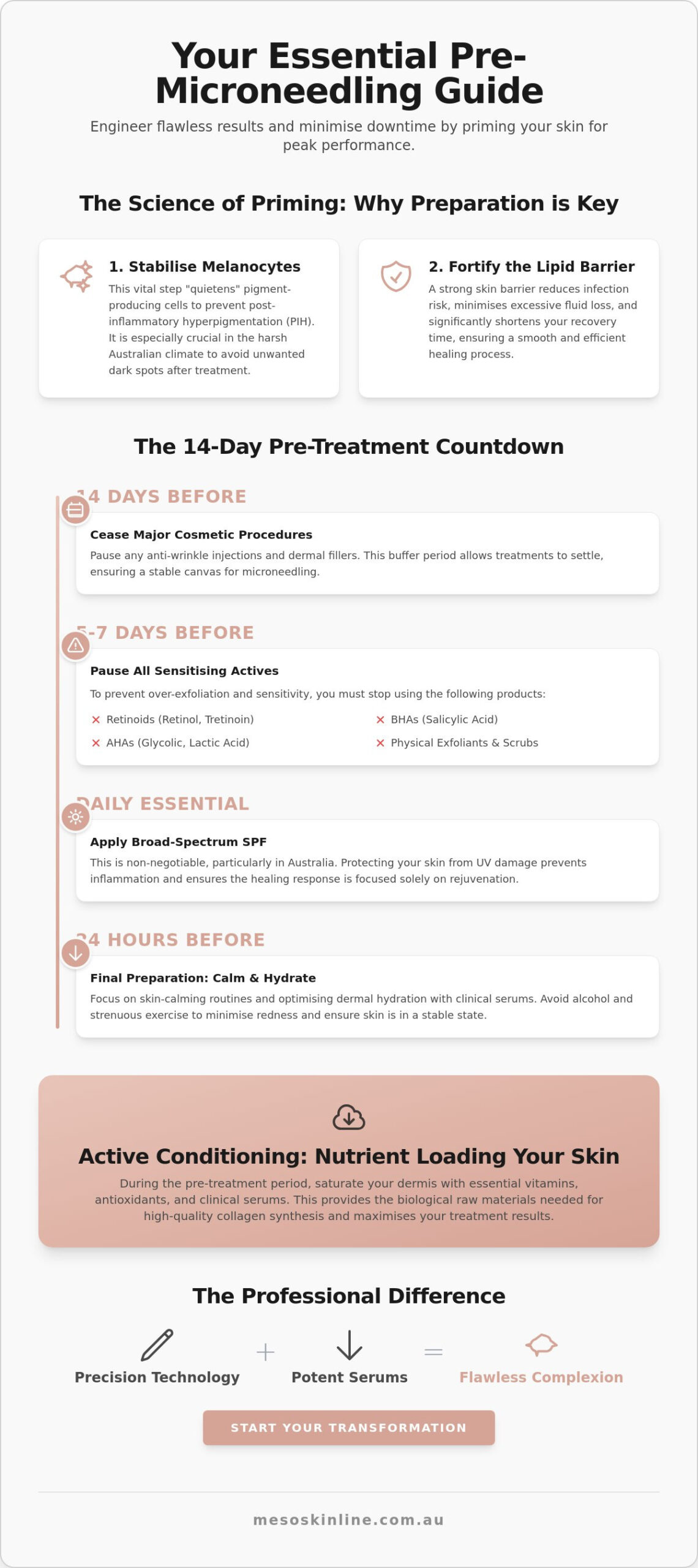
- Learn why stabilising melanocytes and fortifying the lipid barrier is essential for preventing inflammatory responses and ensuring efficient healing.
- Master the essential 14-day timeline for pre-treatment skin prep for microneedling, including the critical cessation of sensitising agents like Vitamin A.
- Optimise your dermal hydration levels with clinical serums to prime the skin for deeper penetration and maximum collagen synthesis.
- Understand the final 24-hour protocols, from lifestyle adjustments to skin-calming techniques, that minimise redness and downtime.
- Explore how professional precision technology and targeted clinical serums work in tandem to deliver a flawless, glowing complexion.
The Science of Priming: Why Pre-Treatment Skin Prep is Non-Negotiable
Excellence in aesthetics is never accidental. It is engineered. Skin priming represents the clinical process of stabilising melanocytes and strengthening the lipid barrier to ensure your complexion is at its physiological peak before any device touches the surface. When we perform Collagen induction therapy (microneedling), we are essentially triggering a controlled wound-healing cascade. Healthy, primed skin responds with surgical efficiency; under-prepared skin often reacts with erratic inflammation. This distinction is what separates a standard treatment from a transformative one.
The concept of “Nutrient Loading” is central to this preparation. By saturating the dermis with essential vitamins and antioxidants before the procedure, you provide the biological raw materials needed for the subsequent inflammatory response. Effective pre-treatment skin prep for microneedling ensures that the micro-trauma leads to high-quality collagen synthesis rather than a chaotic repair process. Without this meticulous preparation, you significantly increase the risk of post-inflammatory hyperpigmentation (PIH), particularly if your skin is already stressed by environmental factors or previous sun exposure.
Stabilising the Skin Barrier
The stratum corneum acts as your primary biological shield. If this barrier is compromised, the risk of opportunistic infection post-procedure increases. A weak barrier also leads to excessive “weeping” of serous fluid or prolonged erythema, which unnecessarily extends your recovery time. We focus on lipid replenishment to ensure the skin can seal itself quickly after the needles are withdrawn. Barrier homeostasis is the foundation of any successful aesthetic intervention.
Melanocyte Management in the Australian Climate
In our harsh Australian climate, melanocyte management is a clinical priority. Our high UV index means many patients present with underlying sun damage that isn’t always visible to the naked eye. We utilise targeted tyrosinase inhibitors as part of our professional pigmentation solutions to “quieten” the pigment-producing cells before treatment. This preventive step is vital for avoiding “rebound” pigmentation, which is a common concern for those with darker Fitzpatrick skin types. Sophisticated pre-treatment skin prep for microneedling allows us to achieve deep dermal penetration while maintaining an impeccable safety profile for every patient.
The 14-Day Countdown: Essential Protocols and Prohibitions
The fortnight leading up to your appointment is a critical window for physiological stabilisation. Success depends on a controlled environment. Effective pre-treatment skin prep for microneedling requires a disciplined approach to your home-care regimen. During this time, we aim to reduce the skin’s reactivity while maintaining its structural integrity. If the skin is in a state of flux or irritation, the results of the procedure become unpredictable. A calm, protected canvas is the only acceptable starting point for clinical excellence.
Broad-spectrum SPF is non-negotiable during this period. In our Australian climate, even incidental sun exposure can trigger melanocyte activity and sub-clinical inflammation. If your skin is even slightly sun-sensitised, we may need to postpone the treatment to avoid the risk of scarring or permanent pigment changes. Protecting the epidermis from UV damage ensures that the wound-healing response is focused entirely on rejuvenation rather than repairing environmental trauma.
Actives to Pause: Managing Cellular Turnover
To ensure the skin’s inflammatory threshold remains manageable, you must cease the use of high-potency sensitising agents. Retinol and prescription Tretinoin should be paused at least 5 to 7 days before your session. While some suggest a shorter window, a full week ensures that cellular turnover isn’t so accelerated that it causes unnecessary peeling or sensitivity during the procedure. Similarly, alpha-hydroxy acids (AHAs) like glycolic acid and beta-hydroxy acids (BHAs) like salicylic acid should be discontinued to prevent over-exfoliation. Check your daily cleansers for “hidden” exfoliants, such as fruit enzymes or low-percentage lactic acid, which can quietly compromise the barrier.
Clinical Contraindications and Timing
The integration of microneedling with other aesthetic treatments requires precise scheduling. We enforce a strict 14-day rule for anti-wrinkle injections and dermal fillers. This buffer allows the product to settle completely and ensures that the micro-trauma from needling doesn’t interfere with the placement of your injectables. For those managing complex skin concerns, integrating pigmentation solutions early in the priming phase can significantly enhance the final result.
Avoid waxing, laser hair removal, or electrolysis in the target area for at least two weeks. These treatments cause lingering inflammation that can skew the results. Additionally, please arrive with skin free of fake tan. The dihydroxyacetone (DHA) in tanning products alters the visible colour of the skin, making it difficult for your practitioner to accurately assess your skin health or monitor for erythema during the treatment.
Active Conditioning: Priming the Canvas with Clinical Serums
While standard advice focuses on what to avoid, the most sophisticated clinical results are achieved through active conditioning. Pre-treatment skin prep for microneedling should be viewed as a period of nutrient loading. By saturating the epidermis with high-performance actives, you increase skin resilience and ensure the regenerative response is immediate and robust. This proactive approach transforms the skin from a passive surface into a highly responsive environment ready for transformation.
Hyaluronic acid is the foundational element of this priming phase. It creates a water-plumped epidermis that facilitates smoother needle gliding, which reduces unnecessary mechanical friction and surface trauma. Simultaneously, peptides act as messenger molecules. They effectively signal the skin to prepare for collagen synthesis, ensuring that the fibroblasts are primed for action the moment the procedure begins. Using clinical-grade formulations is vital during this stage to ensure purity and efficacy, as inferior products may contain contaminants that compromise the skin’s inflammatory threshold.
The Role of Vegan Exosomes in Skin Priming
Innovation in regenerative medicine has introduced vegan exosomes as a premier preparatory tool. These plant-derived vesicles act as powerful catalysts for intercellular communication, carrying essential growth factors and lipids directly to the cells that need them most. For mature or significantly damaged skin, exosome-rich preparation provides a scientific edge. Unlike animal-derived alternatives, vegan exosomes offer a superior safety profile and high biocompatibility, making them ideal for stabilising the skin before a controlled injury is introduced.
Targeted Solutions for Specific Concerns
Precision preparation allows us to address individual skin goals before the first micro-channel is created. For those focused on anti-ageing, integrating Boto Xtreme into your daily routine helps soften expression lines, allowing the subsequent needling to work on a smoother dermal surface. The periorbital area requires even more specialised attention. Using a dedicated Eyelift serum ensures that the delicate skin around the eyes is fortified and hydrated, reducing the risk of post-treatment puffiness.
Hydration loading remains a non-negotiable step for all skin types. A water-rich environment supports the wound-healing cascade and ensures that the skin remains calm throughout the process. Consider these key benefits of active conditioning:
- Enhanced Needle Glide: Deep hydration prevents the device from dragging or snagging.
- Cellular Readiness: Peptides and exosomes “wake up” the skin’s repair mechanisms.
- Reduced Sensitivity: A well-nourished barrier handles micro-trauma with minimal redness.
- Optimised Healing: Nutrient-dense skin closes micro-channels faster, reducing downtime.
The 24-Hour Protocol: Final Steps for the Day of Treatment
The final 24 hours before your appointment represent the transition from preparation to procedure. At this stage, your pre-treatment skin prep for microneedling shifts from active stimulation to physiological stabilisation. The goal is to arrive at the clinic with skin that is hydrated, neutral, and free from any systemic stressors that could exacerbate inflammation or prolong your downtime. Precision in these final hours ensures that the skin’s response to the treatment is both predictable and productive.
Lifestyle choices in this immediate window significantly impact your clinical experience. Alcohol is a known vasodilator; consuming it within 24 hours of your session increases the likelihood of bruising and persistent swelling post-procedure. Similarly, caffeine can heighten your sensory perception, potentially making the sensation of the needles more pronounced than necessary. Choosing herbal infusions or pure water instead will keep your nervous system settled and your skin’s inflammatory threshold high.
Internal Hydration and Diet
Hydration is the secret to dermal turgor. Drinking 2-3 litres of water the day before the treatment improves the “bounce” of the skin, allowing the needles to penetrate with greater precision and less resistance. A clean, antioxidant-rich diet also plays a role in reducing the systemic inflammatory response, ensuring your body is ready to focus entirely on repair. If you are prone to bruising, we recommend discussing blood-thinning supplements with your GP. Common additives like Fish oil or Vitamin E can increase vascular fragility; pausing these under medical guidance can lead to a much cleaner clinical outcome.
Logistics and Hygiene
The “No Makeup” rule is non-negotiable. Even high-end mineral foundations can leave microscopic residues that interfere with professional-grade clinical cleansing and sanitisation. Arriving with a completely bare face ensures that the skin is properly prepared without the need for aggressive scrubbing, which can cause pre-treatment irritation. For patients prone to cold sore outbreaks, the mechanical stimulation of the needles can trigger a flare-up. In these cases, a prophylactic antiviral medication is a vital preparatory step to ensure the healing process remains uninterrupted.
Arriving at the clinic ten minutes early allows your cortisol levels to drop. High stress and elevated cortisol can make the skin more reactive and sensitive to discomfort. When you are relaxed, your body is in the optimal state for advanced clinical protocols, ensuring you receive the maximum return on your aesthetic investment. Mental preparation is just as important as physical prep. Expect a sensation of warmth and tightness during the session, which is a positive sign that the regenerative process has been successfully initiated.
The Professional Difference: Precision Technology and Potent Serums
The culmination of meticulous pre-treatment skin prep for microneedling is the clinical procedure itself. While home preparation primes the biological environment, the technology utilised during the session determines the ultimate precision of the collagen induction. Professional practitioners employ advanced systems like the Mesopowerpen to ensure controlled micro-trauma without the collateral damage associated with inferior devices. This level of technical precision allows for a customised approach; needle depth and speed are calibrated based on the specific resilience and hydration levels achieved during your preparation phase.
Mesoskinline Australia stands as the benchmark for clinical excellence in the APAC region, providing the tools and education necessary for high-tier aesthetic outcomes. By bridging the gap between medical science and luxury aesthetics, we ensure that every micro-channel created serves a specific regenerative purpose. The results of your pre-treatment skin prep for microneedling are only as good as the device used to exploit them. Professional-grade equipment guarantees that the skin’s response is focused entirely on rejuvenation rather than repairing unnecessary surface trauma.
Why Device Quality Matters
Standard dermal rollers often create a “tearing” effect as the needles enter and exit the skin at an angle. This leads to unnecessary epidermal trauma and extended recovery times. In contrast, the Mesopowerpen utilises vertical delivery to create clean, perpendicular micro-channels. Using medical-grade stainless steel needles is a non-negotiable standard for infection control. Beyond the hardware, the value of professional microneedling training cannot be overstated. A skilled practitioner understands how to navigate different facial zones, ensuring safety and efficacy that at-home DIY kits simply cannot replicate.
The Synergy of Serums and Needling
Microneedling creates temporary pathways that increase the absorption of active ingredients by up to 80%. This massive surge in permeability makes the choice of serum critical. During the procedure, only “clean” clinical-grade formulations should be used. These products must be free from perfumes, parabens, and additives that could cause a granulomatous response or foreign body reaction once they reach the deeper dermal layers. By combining precision technology with these potent, sterile actives, we achieve a synergistic effect that accelerates tissue remodelling and enhances the final glow of the complexion.
For practitioners dedicated to delivering superior results and maintaining the highest international standards, we invite you to explore our comprehensive range of mesotherapy supplies. Elevate your clinical practice with the fusion of scientific rigor and premium performance.
Elevate Your Path to Clinical Radiance
Achieving a flawless, glowing complexion is a journey that begins long before you enter the treatment room. By adhering to a rigorous 14-day protocol and prioritising nutrient loading, you ensure your skin is in the optimal physiological state for renewal. This meticulous approach to pre-treatment skin prep for microneedling doesn’t just minimise potential downtime; it amplifies the regenerative effects of the procedure itself. When you combine disciplined preparation with precision technology, the results are both visible and enduring.
Mesoskinline Australia represents the pinnacle of this clinical synergy. Backed by a prestigious European clinical heritage and offered through exclusive APAC distribution, our systems are specifically engineered for professional aesthetic results. Whether you’re a practitioner seeking the highest standards or a client demanding excellence, the fusion of scientific rigour and premium care is the foundation of success. Explore the Mesopowerpen and clinical serums at Mesoskinline Australia to begin your transformation today. Your skin’s most radiant future is within reach.
Frequently Asked Questions
Can I use a chemical peel a week before microneedling?
No, you should avoid professional chemical peels for at least 14 days before your session. Performing a peel too close to your appointment can lead to over-sensitisation and a compromised lipid barrier; this increases the risk of erratic inflammation or adverse reactions during the procedure.
How long should I wait after getting lip fillers before prepping for microneedling?
You must wait a minimum of 14 days after receiving lip fillers or any dermal injectables before beginning the final phase of your pre-treatment skin prep for microneedling. This buffer period allows the injectable product to settle completely and ensures that the micro-trauma from the needles doesn’t interfere with your aesthetic results.
Is it okay to drink coffee on the morning of my skin needling appointment?
It is best to avoid caffeine on the morning of your treatment. As a stimulant, caffeine can heighten your sensory perception and increase your heart rate; skipping your morning brew ensures a more relaxed experience and helps keep your skin’s sensitivity levels stable during the clinical session.
Should I exfoliate my skin at home the night before my treatment?
Do not perform any home exfoliation, whether mechanical or chemical, the night before your appointment. The microneedling process provides intensive cellular stimulation; adding extra exfoliation can lower your inflammatory threshold and cause excessive redness or surface sensitivity that hinders the healing process.
What happens if I have a sunburnt face on the day of my session?
If your face is sunburnt, your practitioner will be unable to proceed and your session will be rescheduled. Treating skin that is already in an acutely inflamed state from UV damage significantly increases the risk of post-inflammatory hyperpigmentation and potential scarring.
Can I use my regular moisturiser as part of my pre-treatment skin prep?
You may continue using your regular moisturiser as part of your pre-treatment skin prep for microneedling, provided it does not contain active exfoliating acids or high-strength retinoids. Focus on using clean, lipid-rich formulas that stabilise the skin barrier and provide deep dermal hydration in the fortnight leading up to your visit.
How many days before the treatment should I stop using my prescription retinoid?
You should cease the use of prescription retinoids or high-potency Tretinoin 5 to 7 days before your appointment. This window allows the skin’s natural barrier function to normalise, ensuring that the epidermis is resilient enough to handle the procedure without excessive peeling or irritation.
Do I need to shave the treatment area before I arrive at the clinic?
Yes, you should cleanly shave the target area on the morning of your appointment if you have significant facial hair. Removing hair ensures the device can glide smoothly over the skin’s surface; it also prevents hair follicles from being disrupted and ensures the micro-channels remain clean and unobstructed.
What Others Are Reading:


Stay in the Glow
Get skincare tips and early access to new products.
