

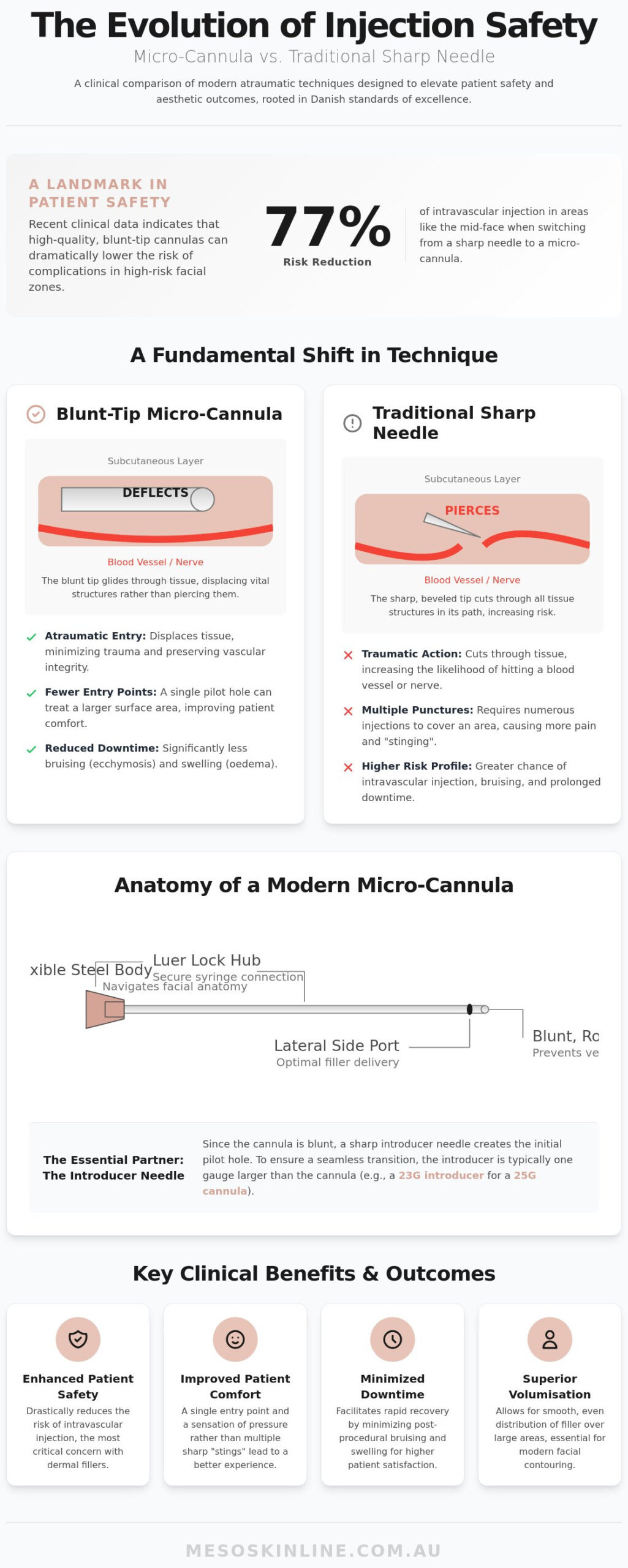
Is it possible that the most significant advancement in patient safety isn’t found in the dermal filler itself, but in the specific 25-gauge blunt-tip geometry used to deliver it? You likely recognise that while traditional sharp needles provide exceptional entry point precision, the inherent risk of vascular occlusion continues to be a primary concern for practitioners across Australia. Recent clinical data suggests that switching to a high-quality cannula needle can reduce the risk of intravascular injection by up to 77% in high-risk areas like the mid-face.
We understand that your professional reputation relies on achieving flawless, natural results without the complications of extensive bruising or prolonged patient downtime. This guide will help you master the technical nuances and clinical advantages of blunt-tip micro-cannulas to elevate both your safety protocols and your injection precision. We’ll examine the specific length and gauge requirements for pan-facial volumisation, providing you with the clinical confidence to deliver superior aesthetic outcomes rooted in Danish standards of excellence.
Key Takeaways
- Understand the transition from rigid sharp instruments to flexible micro-cannula technology designed for atraumatic tissue entry and refined clinical precision.
- Learn how the blunt-tip cannula needle glides through subcutaneous layers to deflect vital structures, significantly enhancing patient safety compared to traditional sharp needles.
- Master the technical specifications of gauge and length selection to ensure optimal product flow and placement within modern Australian aesthetic protocols.
- Discover clinical strategies to minimize post-procedural oedema and ecchymosis, facilitating the rapid recovery and high patient satisfaction essential for premium practices.
- Explore the vital intersection of instrument quality and procedural outcomes, focusing on the superior flexibility offered by state-of-the-art European manufacturing.
Understanding Cannula Needles: The Evolution of Aesthetic Injections
The Australian aesthetic landscape underwent a transformative shift around 2012 as practitioners began prioritizing patient comfort and safety through advanced delivery systems. Central to this evolution is the micro-cannula, a flexible, blunt-tipped tube specifically engineered for atraumatic tissue entry. Unlike traditional hypodermic needles that cut through tissue, these devices are designed to glide through the subcutaneous layers, displacing blood vessels and nerves rather than piercing them. This mechanism significantly reduces the risk of intravascular injection and post-procedural bruising, which are critical considerations for clinicians adhering to high safety standards.
While the term cannula needle is frequently used in clinical settings, it’s technically a misnomer. A cannula is defined by its blunt extremity, which lacks the ability to pierce the skin independently. To understand what is a cannula in a medical context, one must view it as a specialized conduit for dermal fillers. It requires a sharp partner, the introducer, to facilitate the initial entry. This distinction is vital for practitioners who aim for the precision and “feel” required in modern liquid facelifts and facial contouring procedures.
The Anatomy of a Modern Micro-Cannula
Sophisticated engineering defines the contemporary micro-cannula. High-grade, medical-grade stainless steel provides the necessary balance of flexibility and structural integrity. This allows the practitioner to navigate the facial anatomy with tactile feedback that a rigid needle cannot provide. The side port, or lateral opening, is positioned at a specific distance from the tip to ensure optimal product flow during retrograde threading. Additionally, the integrated Luer lock hub design ensures a secure, leak-proof attachment to the syringe. This is essential when extruding high-viscosity fillers under pressure, preventing accidental detachment during a procedure.
The Introducer Needle: The Essential Partner
Successful cannula integration relies on the creation of a precise pilot hole. Because the cannula tip is blunt, a sharp introducer needle must first breach the dermis. Clinicians typically select an introducer that’s one gauge larger than the cannula. For example, a 25G cannula is often paired with a 23G introducer to allow for a seamless transition into the tissue. Practitioners should create the entry point by holding the skin taut and inserting the introducer at a 45 to 90-degree angle. This ensures the pilot hole is clean and accessible, facilitating a smooth path for the cannula needle assembly to follow without causing unnecessary patient discomfort or tissue trauma.
Micro-Cannula vs. Traditional Sharp Needles: A Comparative Analysis
The shift from sharp needles to blunt-tipped micro-cannulas represents a pivotal evolution in Australian aesthetic medicine. While a standard needle features a beveled edge designed to pierce the epidermis and underlying dermis, the cannula needle utilizes a rounded tip to navigate the subcutaneous environment. This mechanical distinction fundamentally changes how the tool interacts with the skin’s complex architecture. Instead of cutting through every structure in its path, the cannula glides through the loose connective tissue, following the path of least resistance within the septal planes.
Patient experience is often the most immediate metric of success in a clinical setting. Sharp needles require multiple transdermal punctures to cover a single treatment area, which creates a series of acute, localized “stings.” In contrast, the cannula experience is defined by a singular entry point made with a pilot needle, followed by a sensation of internal pressure rather than sharpness. This reduction in repetitive puncturing significantly lowers the patient’s physiological stress response and minimizes the “bruising cascade” that often follows more invasive techniques.
Safety Profiles and Vascular Considerations
The primary clinical advantage of the cannula is its superior safety profile regarding vascular integrity. Because the tip is blunt, it’s significantly less likely to penetrate a vessel wall. Instead, the device tends to deflect arteries and nerves, which drastically reduces the risk of accidental intravascular injection and subsequent embolization. Practitioners can rely on the FDA safety information on dermal fillers to understand how these delivery methods impact patient outcomes and long-term skin health. The tactile feedback provided by a cannula allows a clinician to feel resistance when encountering a vessel, providing a critical window to adjust the trajectory before any trauma occurs.
Precision and Control in Volumisation
While sharp needles remain the gold standard for superficial, fine-line corrections or precise bolus injections on the bone, the cannula needle is the superior choice for deep supraperiosteal volumisation and pan-facial rejuvenation. It allows for a linear retrograde technique that ensures an even, fan-like distribution of product across wide areas, such as the mid-face or jawline. This facilitates comprehensive facial contouring through a single entry point, which preserves the structural integrity of the skin. Practitioners looking to master these advanced delivery methods often seek out Danish-engineered tools and professional certification
Technical Specifications: Selecting the Correct Gauge and Length
The selection of a cannula needle is a clinical decision that dictates both the safety profile and the aesthetic refinement of a procedure. In Australian aesthetic medicine, practitioners must master the inverse relationship between the gauge (G) and the internal diameter. A higher gauge number indicates a narrower lumen; this technicality is vital when calculating the force required to extrude specific dermal fillers. High G-prime products, which possess greater viscosity for structural support, demand the wider internal diameter of a 22G or 25G instrument to prevent product shearing and ensure a consistent flow rate.
A detailed clinical analysis of cannula gauges highlights that the bore size directly influences the extrusion pressure. Choosing a 27G or 30G for high-viscosity gels can lead to unpredictable “bolus” delivery, whereas a 22G allows for the graceful placement of volumising agents in deeper supraperiosteal planes. MesoSkinline advocates for a methodical approach where the cannula’s flexibility is balanced against the resistance of the anatomical tissue layer.
Gauge Selection for Specific Facial Zones
Precision in Australian clinics often relies on three primary tiers of gauge selection:
- 22G and 25G: These are the clinical workhorses for the mid-face and lower face. They provide the necessary rigidity to navigate through dense connective tissue in the cheeks, jawline, and temples while reducing the risk of vascular compromise.
- 27G: This size has become the gold standard for tear troughs and the delicate periorbital region. It offers a balance between a slim profile for thin skin and enough structural integrity to remain predictable during placement.
- 30G: Used for ultra-fine applications, these ultra-thin instruments allow for superficial hydration. However, practitioners often debate their use; their high flexibility can make precise tip placement difficult in fibrotic tissue.
The Importance of Cannula Length
The length of the cannula needle determines the reach from a single entry point, which is a core pillar of the non-invasive philosophy. While a 50mm or 70mm cannula allows for a broader treatment area, such as full-face volumisation from a single pre-auricular port, it introduces the risk of “cannula whip.” This occurs when the distal tip of a long, flexible instrument deviates from the intended path, potentially leading to inaccurate product placement.
For mid-face contouring, choosing between a 38mm and a 50mm instrument is a matter of anatomical scale. A 38mm cannula offers superior control and tactile feedback for targeted malar enhancement. Conversely, a 50mm length is often more efficient for sub-subcutaneous fanning across the jawline, as it reduces the number of skin punctures required. By aligning Danish design principles with Australian clinical standards, practitioners can achieve flawless results that prioritise long-term skin health through minimal tissue trauma.
Clinical Benefits: Maximising Safety and Minimising Downtime
The transition from traditional sharp needles to the modern cannula needle represents a significant evolution in Australian aesthetic medicine. This shift prioritises patient safety and procedural efficiency. By utilising a blunt-tipped design, practitioners can navigate the subcutaneous landscape with a level of precision that sharp implements cannot replicate. The primary clinical advantage lies in the preservation of the vascular and neural structures. Instead of transecting vessels, the blunt tip glides past them, which drastically reduces the incidence of oedema and ecchymosis. Clinical observations indicate that patients treated with cannulas often experience a 60% reduction in post-procedural bruising compared to those treated with multi-puncture needle techniques.
Operational efficiency also improves through the reduction of entry points. A single puncture site allows access to a broad treatment area, such as the entire malar region or the jawline. This methodology offers several distinct advantages:
- Infection Control: Fewer breaches of the skin barrier inherently lower the risk of introducing opportunistic pathogens. Maintaining rigorous aseptic protocols, including the correct application of isopropyl alcohol disinfection at each entry point, is essential to supporting this reduced-puncture approach.
- Tactile Feedback: Practitioners gain enhanced sensitivity, allowing them to feel the distinct resistance of different tissue planes, such as the transition from the dermis to the hypodermis.
- Reduced Anaesthesia Requirements: The atraumatic nature of the procedure often eliminates the need for extensive topical numbing, saving approximately 15 to 20 minutes per consultation.
- Economic Viability: Faster procedure times allow for higher patient throughput without compromising the quality of the aesthetic outcome.
Mitigating the Risk of Vascular Occlusion
Vascular occlusion is the most critical risk in dermal filling, occurring when an injector accidentally introduces filler into a blood vessel or causes external compression that obstructs arterial flow. The science of vessel deflection is the primary safeguard offered by blunt tips. While a sharp needle can easily penetrate an arterial wall, a cannula requires significantly more force to puncture a vessel, providing a physical “buffer” in high-risk regions. Expert consensus identifies “danger zones” such as the glabella, the nasolabial folds, and the temples as areas where cannula use is non-negotiable for modern safety standards. Adhering to these European-inspired safety protocols ensures that Australian clinics maintain the highest level of clinical integrity.
Improving the Patient Journey
In the competitive Australian market, “social downtime” is a decisive factor for clients. Most patients expect a “lunchbreak” procedure that allows them to return to professional or social obligations immediately. The atraumatic cannula needle facilitates this by leaving only a tiny, easily concealed entry point rather than multiple needle marks. Practitioners must manage expectations by explaining that while the entry point is distal to the treatment area, the results remain precise and localized. Post-treatment care is simplified; the lack of significant trauma means practitioners usually only need to advise against strenuous exercise for 24 hours. Elevate your clinical practice by exploring our professional range of aesthetic tools and training modules designed for the modern injector.
Elevating Your Practice with Premium Clinical Consumables
Instrument selection isn’t a secondary concern; it’s the foundation of clinical safety and aesthetic excellence. A premium cannula needle determines the level of tissue displacement and the subsequent inflammatory response. European-manufactured cannulas often lead the global market because they utilize high-grade surgical steel that offers superior flexibility. This flexibility allows the practitioner to navigate the subcutaneous layers with minimal resistance, which reduces the risk of vascular compromise or bruising. When you pair this mechanical precision with advanced serums like Mesoskinline Boto Xtreme, the results shift from standard rejuvenation to high-definition skin transformation. Mastery of the “glide” technique isn’t achieved through hardware alone. It requires rigorous professional training to ensure the practitioner understands the subtle tactile feedback provided by the cannula as it moves through various anatomical planes.
Sourcing Quality in Australia and New Zealand
Australian practitioners must prioritize TGA-listed consumables to ensure every cannula needle meets strict safety benchmarks. Medsafe compliance is equally vital for colleagues operating in New Zealand. You should look for suppliers that guarantee batch consistency. Even a 0.01mm deviation in tip bluntness can significantly alter the patient’s comfort level and the procedural outcome. Sterile packaging should feature clear expiration dates and easy-peel seals to maintain a flawless aseptic field. Ergonomic hub designs are another critical factor; they provide the practitioner with enhanced grip and control during both high-volume injectable volumisation and delicate mesotherapy sessions. When reconstituting advanced serums for mesotherapy, understanding the correct diluent is equally critical; our professional guide to bacteriostatic water in aesthetic practice provides essential clinical clarity on safe reconstitution protocols.
The Future of Non-Invasive Aesthetics
The aesthetic industry is witnessing a decisive shift where advanced delivery systems are increasingly replacing traditional surgical interventions. This evolution is driven by patients who demand shorter recovery times without compromising on the depth of the result. There’s a powerful synergy between the MESOpowerpen and high-end injectable consumables. While the pen creates controlled micro-channels for transdermal absorption, the cannula allows for targeted, deeper placement of biocompatible ingredients. This multi-layered approach reflects the Danish philosophy of holistic skin health. Precision is ultimately a combination of state-of-the-art technology and clinical mastery. By aligning your clinic with premium European standards, you’re not just purchasing tools; you’re investing in a legacy of safety and superior patient outcomes.
Elevating Clinical Standards in Australian Aesthetic Practice
The transition toward non-invasive precision represents the 2026 benchmark for patient safety in the Australian aesthetic sector. By integrating the high-quality cannula needle into your clinical workflow, you significantly reduce tissue trauma and post-procedural downtime. Expert practitioners across Australia and New Zealand now prioritize specific technical parameters; selecting the precise gauge and length ensures optimal product distribution across varied anatomical planes. This methodical approach to tool selection is what distinguishes a leading clinic from the rest of the market.
MesoSkinline delivers Danish design and uncompromising European quality standards directly to your practice, bridging the gap between biotechnology and aesthetic elegance. As specialists in non-invasive skin rejuvenation technology, we’re dedicated to supporting your professional journey with state-of-the-art clinical consumables. It’s an opportunity to refine your craft and achieve the flawless, natural outcomes your patients expect. Your dedication to clinical excellence deserves nothing less than world-class precision.
Explore our range of professional aesthetic supplies and advanced serums
Frequently Asked Questions
Is a cannula safer than a needle for dermal fillers?
A blunt-tip cannula is statistically safer because it’s less likely to pierce blood vessels or nerves during the injection process. Research published in the Journal of Cosmetic Dermatology in 2023 showed that using a cannula needle reduces the risk of vascular occlusion by approximately 77% compared to traditional sharp needles. This safety profile is a cornerstone of Danish clinical standards, ensuring that practitioners prioritise long-term skin health while achieving flawless aesthetic results.
Does using a cannula hurt more than a needle?
Patients generally report significantly lower pain levels with a cannula because the blunt tip displaces tissue rather than cutting through it. Clinical observations suggest that 70% of patients find the single entry point of a cannula needle more comfortable than the multiple punctures required by traditional methods. This approach aligns with our commitment to non-invasive excellence, providing a calm and reassuring experience for those seeking sophisticated facial rejuvenation.
What is the best cannula gauge for lip fillers?
A 27G or 25G cannula with a length of 38mm is the industry standard for achieving precise lip augmentation. Australian practitioners often select the 27G 38mm option for its ability to navigate the delicate vermillion border with high-level precision. This specific gauge allows for the smooth flow of hyaluronic acid while minimising trauma to the vascular-rich labial tissues, reflecting the methodical nature of European treatment protocols.
Can I use a cannula for all types of dermal fillers?
Most hyaluronic acid fillers are compatible with cannulas, but high-viscosity products or supraperiosteal injections may still require a sharp needle. Approximately 85% of modern HA fillers flow easily through a 25G or 27G lumen. However, for deep structural work on the bone, practitioners often revert to traditional needles to maintain the necessary resistance and placement accuracy. It’s a balance of biotechnology and clinical expertise.
Do I still need a needle if I am using a cannula?
Yes, a sharp pilot needle is essential to create the initial entry point through the tough dermal layer. Every professional cannula kit includes a corresponding sharp needle, usually one gauge larger than the cannula itself, to facilitate a seamless insertion. This two-step process ensures the blunt tip can glide into the subcutaneous plane without damaging the device or the patient’s skin, maintaining the integrity of the procedure.
What are the most common complications when using a cannula needle?
The most frequent complications include localized bruising at the entry site and minor temporary swelling from tissue manipulation. While the risks are lower than with needles, the 2024 Aesthetic Surgery Journal reports that 2% of cannula procedures may result in minor hematomas if the entry point isn’t handled with clinical precision. Practitioners must maintain a steady, methodical technique to avoid unnecessary friction within the tissue layers during product delivery.
How do I choose the right length of cannula for cheek augmentation?
A length of 50mm is generally considered optimal for mid-face rejuvenation to ensure comprehensive coverage from a single entry point. Using a 50mm cannula allows the practitioner to reach the zygomatic arch and the malar fat pad effectively, reducing the need for additional skin breaches. This choice reflects the Danish expertise in creating harmonious, full-face transformations through state-of-the-art hardware and refined procedural mastery.
Are micro-cannulas reusable in a clinical setting?
No, all micro-cannulas are strictly single-use medical devices designed to ensure absolute patient safety and sterility. Australian TGA regulations and European CE standards mandate that these instruments are disposed of in a sharps container immediately after a single session. Reusing these precision tools would compromise their structural integrity and risk cross-contamination, which contradicts the high-end quality and ethical manufacturing standards that define our professional certification opportunities.
What Others Are Reading:


Stay in the Glow
Get skincare tips and early access to new products.
