
Microneedling Protocol for Stretch Marks: The 2026 Clinical Guide for Australian Practitioners
Treating mature striae alba with a standard 1.5mm depth is no longer the clinical gold standard for Australian aesthetic clinics. While most practitioners understand the basic mechanics of collagen induction, many continue to face the professional frustration of inconsistent results and client dissatisfaction when addressing older, silvered scar tissue. Mastering a repeatable, high-efficacy microneedling protocol for stretch marks requires moving beyond generic settings to embrace a sophisticated fusion of precision mechanical trauma and targeted bio-active infusion.
You likely recognise that the challenge isn’t just the depth of the needle; it’s how the tissue responds to the specific serums introduced during the inflammatory phase. We promise to equip you with the exact clinical parameters and advanced serum protocols needed to transform stubborn striae into smooth, resilient skin. This guide examines the latest TGA compliance principles for 2026, the strategic application of vegan exosomes, and the technical specifications of the Mesopowerpen to help you optimise your clinical outcomes and business profitability.
Key Takeaways
- Understand why topical solutions often fail and how controlled dermal trauma triggers the essential collagen induction necessary for genuine tissue revision.
- Master a precise microneedling protocol for stretch marks by tailoring needle depth and oscillation speed to specific anatomical zones, such as the abdomen and breasts.
- Identify the three critical phases of dermal repair, inflammation, proliferation, and remodelling, to better manage client expectations and treatment intervals.
- Learn to integrate high-potency bio-actives like vegan exosomes into your sessions to accelerate cellular regeneration and significantly reduce patient downtime.
- Discover how the Mesopowerpen’s advanced motor control ensures uniform penetration into deep striae while protecting the skin’s structural integrity.
Understanding Striae: Why Microneedling is the Gold Standard for Stretch Mark Reduction
Striae distensae represent more than a cosmetic concern; for many Australians, they impact the confidence required to fully embrace our coastal lifestyle. In a culture where beach days and outdoor activities are central to our social fabric, skin texture often dictates personal comfort. While the market is saturated with topical creams, these formulations rarely penetrate the epidermal-dermal junction. They fail because a stretch mark is not a surface scar. It’s a structural tear within the dermis. This is why a professional microneedling protocol for stretch marks has emerged as the clinical gold standard. By bypassing the skin’s barrier and delivering controlled micro-trauma directly to the site of the rupture, we initiate a genuine biological reset.
This process, known as collagen induction therapy, leverages the body’s innate wound-healing cascade. In 2026, clinical consensus has shifted away from aggressive ablative lasers that carry high risks of post-inflammatory hyperpigmentation, particularly for our diverse Australian skin types. Instead, mechanical needling offers a safer, more precise alternative that preserves the epidermis while stimulating a robust dermal response. It’s a sophisticated approach that respects the skin’s integrity while demanding visible transformation.
Striae Rubra vs. Striae Alba
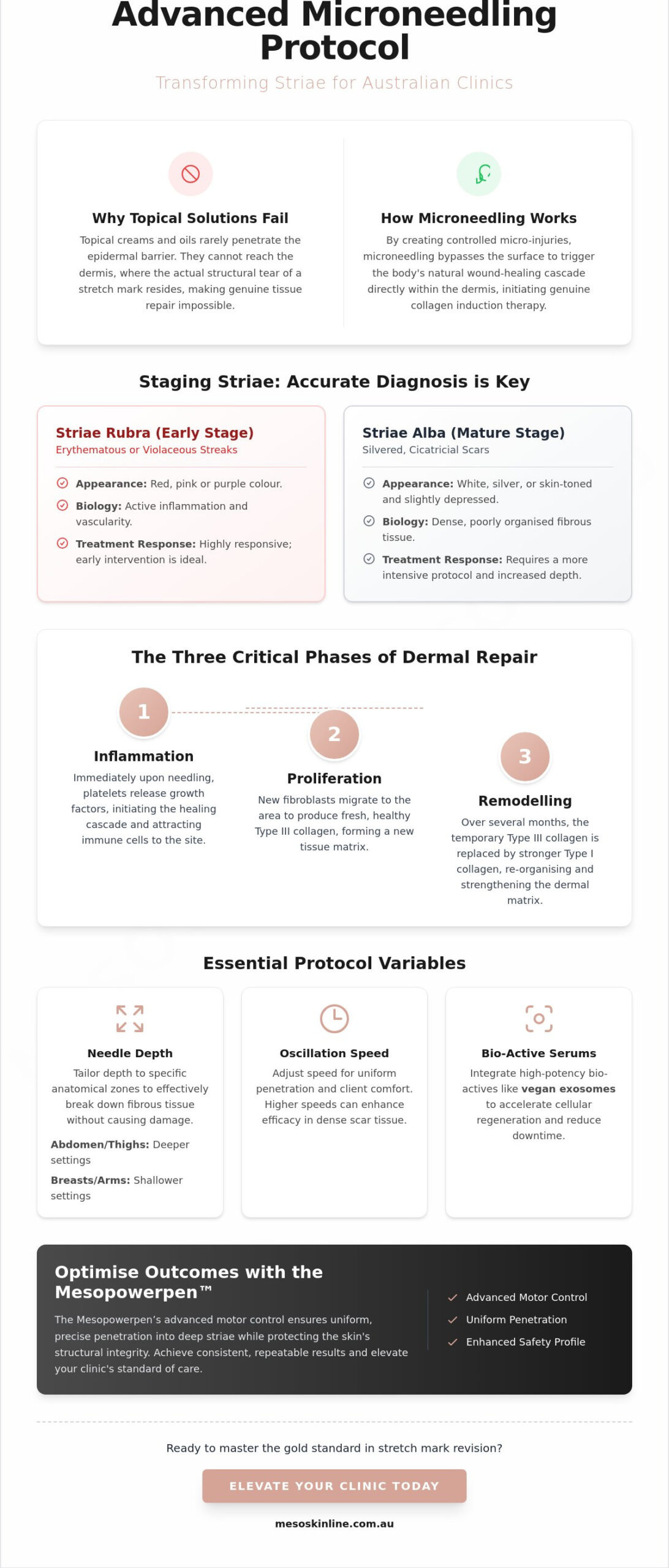
Successful outcomes depend on your ability to stage the tissue accurately. Striae rubra, the initial inflammatory phase, presents as erythematous or violaceous streaks. These are highly responsive to treatment due to active vascularity. Early intervention here can often prevent the progression to striae alba. These older, silvered marks are cicatricial in nature. They require a more intensive microneedling protocol for stretch marks with increased needle depth to break down the dense, poorly organised fibrous tissue and encourage new, healthy collagen synthesis. Managing client expectations is vital; older marks may require more sessions, but the regenerative potential remains significant.
The Role of the Dermal Matrix
During periods of rapid expansion, the skin’s structural integrity is compromised. The dermal matrix, specifically the network of elastin and collagen fibres, literally snaps under tension. This creates a “gap” that the body fills with thin, disorganised connective tissue. Microneedling doesn’t just create holes; it triggers a sophisticated three-phase repair system.
- Inflammation: Platelets release growth factors immediately upon needling.
- Proliferation: New fibroblasts migrate to the area to produce fresh Type III collagen.
- Remodelling: Over several months, Type III collagen is replaced by stronger Type I collagen, re-organising the matrix to match the surrounding skin.
This methodical re-organisation is what eventually bridges the dermal gap. The result is a visible reduction in the width and depth of the striae, creating a smoother skin profile that mirrors the surrounding healthy tissue.
The Biological Mechanism: How Precision Skin Needling Repairs the Dermal Matrix
Microneedling for stretch marks is a sophisticated, minimally invasive procedure that utilises high-speed oscillating needles to create thousands of controlled micro-injuries within the dermal layer. This intentional trauma bypasses the skin’s surface without ablating the epidermis. It’s a calculated disruption designed to restart the biological clock of a scar. By following a rigorous microneedling protocol for stretch marks, practitioners can effectively treat the underlying structural deficits that topical solutions simply cannot reach. The goal is to replace disorganised scar tissue with a functional, healthy dermal matrix.
The efficacy of this approach is backed by rigorous scientific data. A recent Microneedling for Striae Distensae Meta-Analysis confirms that this modality significantly improves skin texture by triggering a predictable three-stage repair cycle. This cycle is not immediate; it is a profound physiological transformation that moves from acute inflammation to the long-term synthesis of new tissue. It requires patience from both the practitioner and the client to allow the body’s natural regenerative processes to conclude.
One of the most critical aspects of treating striae alba, or white stretch marks, is the induction of angiogenesis. These marks are often described as “dead” tissue because they lack significant blood flow and appear pale and atrophic. Precision needling stimulates the formation of new capillaries, bringing oxygen and vital nutrients back to the fibrotic area. This revitalisation is essential for neocollagenesis, the production of Type III collagen which eventually matures into the more resilient Type I collagen. For practitioners looking to elevate these biological results, utilising a high-performance Mesopowerpen ensures that needle penetration is vertical and consistent, preventing unnecessary epidermal tearing and ensuring the micro-channels are perfectly primed for serum infusion.
The Inflammatory Response
The journey toward smoother skin begins with the release of growth factors, specifically TGF-beta 3. This specific growth factor is a key driver of scarless healing. Unlike the TGF-beta 1 and 2 found in traditional wounding, TGF-beta 3 promotes a more organised collagen structure. Neutrophils and macrophages quickly enter the site to clear away damaged elastin and fragmented collagen fibres. This controlled inflammatory phase is the mandatory catalyst for dermal thickening. It sets the stage for the subsequent phases of repair to occur with the necessary intensity.
Collagen Remodelling and Maturation
During the proliferation phase, new collagen fibres begin to bridge the dermal tear. However, the most visible aesthetic changes usually appear between the three and six-month mark. This is when the disorganised “basket-weave” of the scar tissue is replaced by a more parallel alignment of collagen that matches the surrounding healthy skin. The indented, “crinkled” texture of the striae begins to smooth out as the dermal matrix regains its volume. The maturation phase serves as the final stage of the repair cycle where the newly formed collagen fibres contract and tighten to provide long-term structural support.
Essential Protocol Variables: Needle Depth, Speed, and Serum Selection
Developing a high-efficacy microneedling protocol for stretch marks requires more than just clinical knowledge; it demands a nuanced understanding of anatomical variation. You can’t treat the delicate skin of the breasts with the same aggressive parameters used for the abdomen or hips. Inconsistent results usually stem from a failure to adapt to these regional differences. A successful practitioner treats the skin as a map of varying densities and sensitivities, adjusting their device settings in real-time to match the tissue’s resistance.
Needle speed is a critical, yet often overlooked, variable in body treatments. When working on large surface areas, lower oscillation speeds can lead to ‘drag’. This occurs when the needles don’t retract fast enough during the practitioner’s lateral movement, causing painful epidermal tearing rather than clean micro-channels. High-frequency oscillation is essential to ensure clean, vertical entry and exit, which preserves the skin’s integrity and reduces post-treatment erythema.
The choice of cartridge also dictates the success of the intervention. While 36-pin cartridges are efficient for general skin rejuvenation, the 12-pin configuration is often superior for the dense, fibrotic tissue found in mature striae alba. The lower needle count reduces the ‘bed of nails’ resistance, allowing the needles to penetrate more effectively into the deep dermal tear without requiring excessive pressure. This precision is what separates a standard beauty treatment from a clinical-grade revision.
Calibrating Needle Depth for Body Areas
For the abdomen and hips, where the skin is thicker and the striae often deeper, you’ll typically need to reach the deep dermis with depths between 1.5mm and 2.5mm. Conversely, the breasts and inner arms possess much thinner skin; here, depths should be restricted to 0.5mm to 1.0mm to avoid damaging underlying structures. Regardless of the area, your clinical endpoint is uniform pinpoint bleeding. This indicates you’ve successfully reached the papillary dermis, the primary site for fibroblast activation and subsequent collagen synthesis.
Serum Infusion: Beyond Basic Hydration
The micro-channels created during needling provide a brief window of opportunity for dermal infusion. Standard moisturisers are insufficient; you must use sterile, professional-grade serums with a low molecular weight to ensure they actually reach the dermal tear. Hyaluronic acid acts as an ideal delivery vehicle, but the choice of active ingredients should be dictated by the scar’s stage. For instance, incorporating pigmentation solutions is essential when treating striae rubra or post-inflammatory hyperpigmentation, as it helps to unify the skin tone while the mechanical needling addresses the texture.
The Clinical Step-by-Step: A Professional Microneedling Protocol for Stretch Marks
Implementing a rigorous microneedling protocol for stretch marks ensures both safety and clinical efficacy in a professional setting. It begins with a comprehensive consultation where you must assess the client’s skin type using the Fitzpatrick scale. This is vital for managing the risk of post-inflammatory hyperpigmentation, particularly in the Australian climate. Once the treatment area is identified, a double-cleanse and thorough degreasing with a clinical disinfectant are mandatory to prevent infection. In many Australian jurisdictions, you may apply a topical anaesthetic to ensure client comfort, provided you comply with the relevant Poisons Standard and local scheduling regulations.
Preparation and Safety
Screening for contraindications is a non-negotiable first step. Don’t treat clients with active eczema, psoriasis, or those currently on anticoagulant medication. To maintain an impeccably sterile environment, use bacteriostatic water for all procedural cleaning and site preparation. Your workstation setup should be meticulous; when using the Mesopowerpen, ensure all components are sterile and your technique avoids any chance of cross-contamination. This level of precision protects your professional reputation and your client’s wellbeing.
The Needling Technique
Achieving the right depth requires more than just setting a dial. It requires refined technique. Maintain a strict 90-degree perpendicular entry with the needles to prevent scratching the epidermis and to ensure the micro-channels are clean and vertical. For abdominal striae where the skin is often loose, use the ‘stretch and hold’ method to create a firm surface. This allows the needles to penetrate to the intended depth without the tissue ‘bouncing’ away from the cartridge. You can use a ‘cross-hatch’ pattern or small circular motions, depending on the width and density of the marks. Continue until you observe uniform erythema and pinpoint bleeding. Usually, two to three passes are sufficient for most body areas.
Post-Treatment Care and Recovery
The immediate post-treatment phase is the most critical window for bio-active infusion. Apply your chosen serum while the channels remain open and follow this with an occlusive protection to lock in moisture. Your client’s recovery depends on their adherence to aftercare. For the first 24 hours, they must avoid heat, excessive sweating, and direct sun exposure. Provide them with a microneedling aftercare checklist to ensure they support the remodelling phase correctly at home. Long-term results are sustained by using specialised serums that nourish the maturing collagen over the following months.
To achieve these precise results and elevate your treatment standards, consider integrating the Mesopowerpen into your clinical workflow.
Optimising Clinical Outcomes with the Mesoskinline Professional System
The Mesopowerpen represents the pinnacle of engineering for this specific application. When executing a microneedling protocol for stretch marks, the device’s motor stability is paramount. Inconsistent needle oscillation often leads to micro-tearing or jagged channels. The Mesopowerpen ensures vertical precision even at the 2.5mm depths required for dense abdominal striae. This mechanical stability translates directly to better clinical outcomes and reduced procedural stress for the practitioner. It allows you to focus on the artistry of the revision while the technology handles the rigorous demands of dermal penetration.
From a commercial perspective, stretch mark revision is a high-value service that can significantly bolster clinic ROI. Packaging these treatments into a structured series of four to six sessions ensures both clinical efficacy and a predictable revenue stream. By positioning your practice at the intersection of medical science and luxury aesthetics, you attract a clientele that prioritises visible transformation and is willing to invest in premium, results-driven protocols. Success in 2026 is defined by this fusion of high-tier hardware and business-savvy treatment packaging.
The Power of Vegan Exosomes
Integrating vegan exosomes into your clinical workflow introduces a level of regenerative science previously reserved for medical-grade wound healing. Exosomes are nano-sized signalling molecules that act as the skin’s internal communication system. They instruct dormant fibroblasts to accelerate the repair of the ruptured dermal matrix. Unlike animal-derived alternatives, vegan-sourced exosomes offer a high-performance, ethically aligned solution for the discerning Australian market. Clinical evidence continues to show that combining these bio-actives with needling significantly reduces patient downtime while amplifying the density of new collagen fibres.
Partnering for Success
Sustaining clinical excellence requires more than just high-tier equipment; it demands a strategic partnership. Mesoskinline Australia provides exclusive distribution and local support, ensuring you have access to international quality standards without the logistical delays of offshore procurement. To truly master the nuances of these treatments, practitioners are encouraged to access advanced facial courses designed to elevate your methodology and refine your technical execution. These courses provide the clinical depth needed to manage complex cases and ensure your microneedling protocol for stretch marks remains at the forefront of the industry.
Elevate your practice and offer your clients the gold standard in skin revision. Enquire today about the Mesopowerpen and our professional range of high-potency serums to start your journey toward clinical mastery.
Mastering the Future of Dermal Revision
The journey from identifying striae rubra to successfully revising mature striae alba requires a sophisticated blend of technical skill and high-performance technology. We’ve explored how a meticulous microneedling protocol for stretch marks relies on the synergy between precise needle depth, vertical oscillation, and the infusion of advanced bio-actives. By understanding the three phases of dermal repair and tailoring your approach to specific anatomical zones, you can deliver the consistent, high-efficacy results that Australian clients expect.
As the exclusive Australian distributor of Danish-engineered technology, we provide the tools and training necessary to lead the market. Our system offers more than just the Mesopowerpen; it provides access to clinically proven formulations like Boto Xtreme and Vegan Exosomes that accelerate tissue regeneration. Through our comprehensive certification programs, you can ensure your clinic operates at the intersection of medical science and luxury aesthetics.
Elevate your clinic with the Mesopowerpen and professional stretch mark protocols and join a network of practitioners dedicated to setting new international standards in skin longevity. We look forward to supporting your professional success.
Frequently Asked Questions
How many microneedling sessions are typically needed for stretch marks?
Most practitioners recommend a series of four to six sessions to achieve visible dermal re-organisation. While striae rubra may show improvement after just two treatments, mature striae alba require a more sustained approach to effectively break down fibrotic tissue and stimulate new collagen. The exact number depends on the age of the marks and the client’s individual healing response.
Can microneedling completely remove old, white stretch marks?
Microneedling provides significant clinical improvement in texture and colour, but it rarely removes striae alba entirely. Because these marks represent a permanent tear in the dermal matrix, the goal is revision rather than total eradication. A professional microneedling protocol for stretch marks focuses on narrowing the width of the marks and smoothing the indented ‘crinkled’ texture to match the surrounding healthy skin.
What is the recommended needle depth for treating stretch marks on the stomach?
For the abdominal area, a needle depth of 1.5mm to 2.5mm is typically required to reach the deep dermal rupture. The skin on the stomach is often thicker than other body parts, necessitating deeper penetration to trigger the wound healing cascade. Practitioners should always adjust the depth based on the client’s tissue resistance and the visual endpoint of uniform pinpoint bleeding.
Is microneedling for stretch marks painful for the client?
The procedure is generally described as mildly uncomfortable rather than painful, especially when using high-speed devices like the Mesopowerpen. The rapid oscillation of the needles minimises the duration of the sensation and prevents epidermal dragging. In Australian clinics, the application of a topical anaesthetic according to local regulations can further enhance client comfort during deeper body treatments.
How long should a practitioner wait between stretch mark needling sessions?
A recovery period of four to six weeks between sessions is essential to allow the proliferation and remodelling phases to conclude. Performing treatments too frequently can interrupt the natural synthesis of Type I collagen and lead to suboptimal results. This interval ensures the skin’s structural integrity is maintained while the new dermal matrix matures and strengthens.
Can I use a derma roller instead of a professional microneedling pen for stretch marks?
Manual derma rollers are not recommended for a professional microneedling protocol for stretch marks due to the risk of epidermal tearing. Rollers enter and exit the skin at an angle, which creates a ‘V’ shaped wound that increases downtime and trauma. Electronic pens provide vertical penetration, ensuring cleaner micro-channels and more precise delivery of bio-active serums into the dermal tear.
What are the most common side effects of needling on the body?
The most frequent side effects include transient erythema, mild swelling, and pinpoint bleeding, all of which are normal clinical indicators. Some clients may experience a sensation similar to a mild sunburn or temporary dryness in the treated area for 24 to 72 hours. These effects are part of the controlled inflammatory response and typically resolve quickly with appropriate post-treatment care.
Are vegan exosomes safe to use during a microneedling treatment?
Vegan exosomes are highly safe and offer an ethically sound, high-performance alternative to animal-derived signalling molecules. They are bio-compatible and specifically engineered to communicate with skin cells to accelerate regeneration without the risks associated with human-derived products. When infused during needling, they significantly enhance the repair process and reduce the overall recovery time for the client.
What Others Are Reading:


Stay in the Glow
Get skincare tips and early access to new products.
