
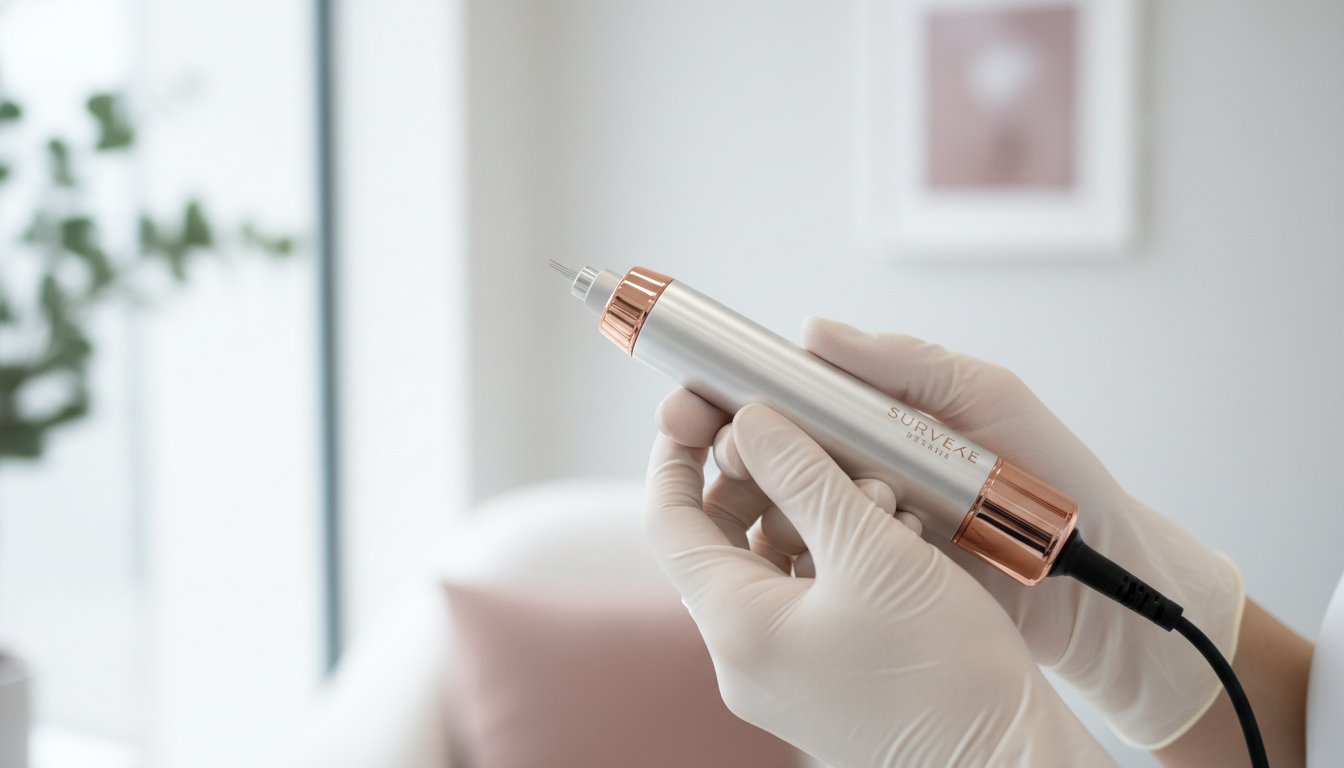
Imagine you’re mid-procedure, the client is relaxed, and suddenly your device stutters or starts to drag across the dermis. It’s a practitioner’s worst nightmare. When it comes to troubleshooting a professional microneedling pen, the difference between a minor hiccup and a clinical failure lies in your technical literacy. You’ve invested in high-tier hardware like the MesoPower Pen to deliver transformative results, so a mechanical inconsistency feels like a breach of your professional promise.
We understand that maintaining a seamless workflow is essential for both patient safety and your clinic’s reputation. This guide provides the expert-led protocols you need to resolve motor stutters immediately and eliminate the risk of needle drag. You’ll learn how to optimise your device’s lifespan while upholding the rigorous sterile standards expected in a modern aesthetic environment. From identifying power supply fluctuations to ensuring cartridge alignment, we’re providing the technical roadmap to ensure your clinical outcomes remain flawless and your hardware remains a reliable asset for years to come.
Key Takeaways
- Learn to distinguish between minor mechanical stutters and critical hardware failures to maintain clinical safety and professional standards.
- Master the art of troubleshooting a professional microneedling pen by identifying battery fatigue and motor fluctuations before they impact patient comfort.
- Eliminate needle drag and tramlining by synchronising needle depth with motor speed for precise, vertical micro-perforations.
- Protect your clinical investment by preventing fluid backflow and managing the residues that compromise internal motor integrity.
- Recognise the technical signs of irreparable motor wear and understand when upgrading to a Mesopowerpen ensures continued treatment excellence and business profitability.
Understanding Professional Microneedling Pen Diagnostics
Precision is the hallmark of the modern aesthetic clinic. When we discuss troubleshooting a professional microneedling pen, we aren’t simply “fixing a tool”; we are performing a systematic verification of clinical safety and mechanical integrity. This process involves a rigorous audit of motor stability, needle alignment, and power consistency to ensure every puncture is vertical and precise. Unlike entry-level devices, professional hardware must adhere to the Therapeutic Goods Administration (TGA) standards in Australia, which classify these as Class II medical devices. Compliance isn’t just a legal necessity. It’s the foundation of the predictable reliability that high-volume clinics require to protect their reputation and patient outcomes.
Distinguishing between a minor mechanical stutter and a critical hardware failure is a vital skill for any practitioner. A stutter might be a simple debris obstruction in the cartridge housing, whereas a critical failure often involves internal motor fatigue or a compromised drive bar. Every practitioner should maintain a detailed service log for every device in the clinic. This log tracks treatment hours, cartridge batches, and any audible anomalies during procedures. It transforms reactive maintenance into a proactive business strategy that safeguards your clinical schedule.
The Anatomy of a Clinical-Grade Pen
The internal architecture of a device dictates the quality of the treatment. High-end systems like the Mesopowerpen are engineered for absolute stability, using precision-milled components to eliminate lateral vibration. At its core, the relationship between the internal motor and the needle drive bar determines the efficacy of Collagen induction therapy (microneedling). Finding the “sweet spot” for speed settings is essential; thicker dermal tissue requires higher oscillation frequencies to ensure the needles exit the skin before the pen moves. This technical synchronisation prevents epidermal tearing and ensures a comfortable experience for the client.
Initial Triage: The 60-Second Check
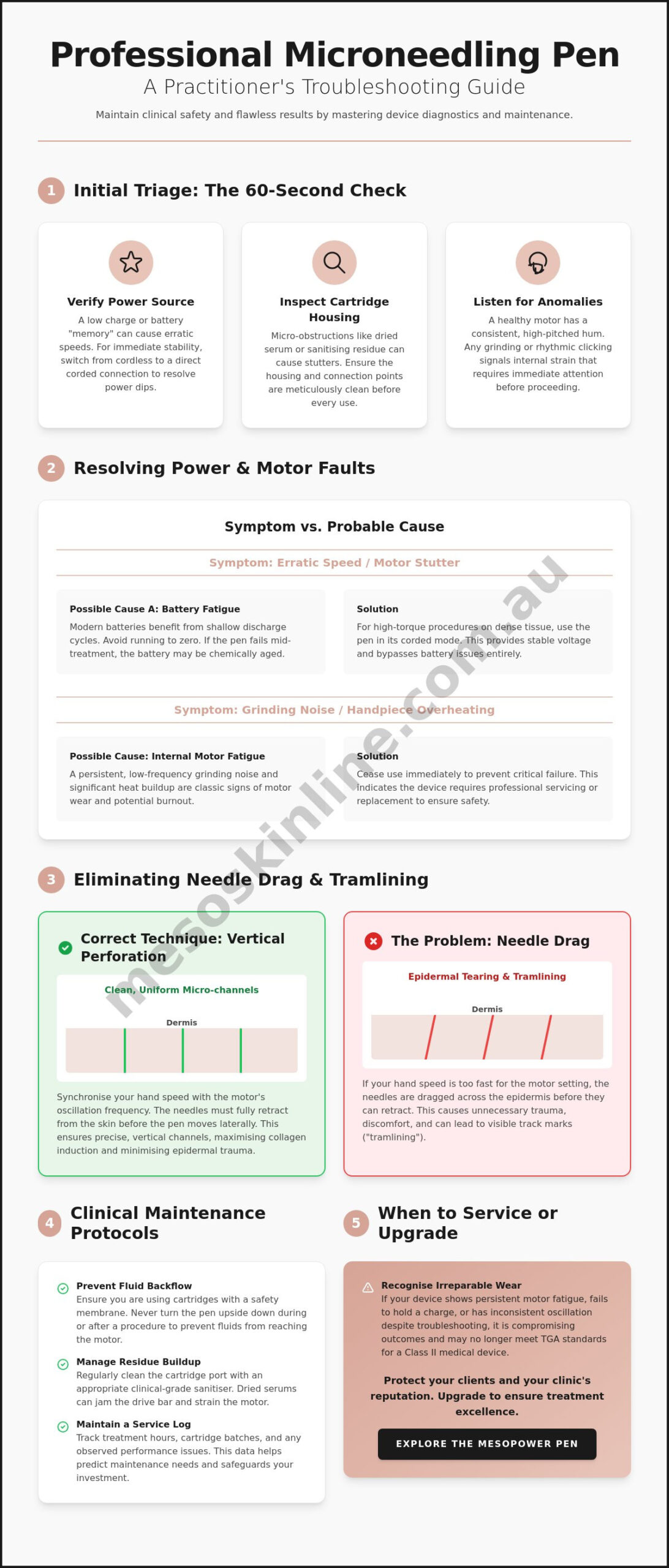
Before escalating a technical issue, perform a rapid 60-second triage to rule out simple environmental factors. Start by verifying your power source stability. Cordless models offer mobility, but battery “memory” or a low charge can lead to erratic speeds; switching to a corded connection often resolves immediate power dips. Next, inspect the cartridge housing for micro-obstructions such as dried serum or sanitising residue. Finally, listen. A healthy motor has a consistent, high-pitched hum. Any grinding or rhythmic clicking signals internal strain that requires immediate attention before your next session begins. It’s a small check that prevents a mid-treatment failure.
Resolving Power Inconsistencies and Motor Fatigue
Maintaining a consistent oscillation frequency is paramount for creating uniform micro-channels across the treatment area. When troubleshooting a professional microneedling pen, erratic speed fluctuations are often the first indicator of an underlying electrical or mechanical discrepancy. These dips in power don’t just affect the efficiency of the procedure; they compromise the precision of every puncture, potentially leading to unnecessary epidermal trauma. For deep dermal work, practitioners often find that corded operation provides a more stable frequency. A direct power connection eliminates the variable voltage inherent in a depleting battery, providing the high-torque stability required to penetrate denser tissue without the motor flagging.
Scientific literature, including a Clinical review of microneedling procedures, emphasises that controlled injury is the absolute goal of any session. If a motor is fatigued, that control is lost. Motor burnout typically presents as a persistent heat buildup in the handpiece or a low-frequency grinding noise. In contrast, simple debris buildup in the needle port usually manifests as a sharp, rhythmic clicking or a sudden mechanical jam. Keeping the port clear of dried serum and sanitising agents is a basic yet critical maintenance step that extends the life of your clinical hardware.
Battery Optimisation for Back-to-Back Sessions
The “full charge” myth is a common pitfall in high-volume salons. Modern lithium-ion batteries, like those found in the Mesopowerpen, actually benefit from shallow discharge cycles rather than being run to zero. If your pen fails mid-afternoon, it’s likely a sign of battery “memory” or chemical aging from improper charging habits. To ensure professional reliability, avoid leaving the device on the charger overnight once it reaches 100%. Always verify your specific model’s safety protocols before using the device in “plug-and-play” mode while it’s connected to a power outlet, as some circuits aren’t designed for simultaneous charging and high-speed operation.
Motor Synchronisation and Speed Calibration
A “laboured” sound during a procedure usually indicates the motor is struggling against skin resistance, which is common when treating fibrous scar tissue. This internal strain generates significant heat. If you notice the digital display flickering, it’s a warning that the internal PCB is under thermal duress. You can often recalibrate the system by powering the device down completely for 60 seconds to reset the logic board. Limiting treatment times to 30 minutes per device allows the motor to cool, preventing the thermal expansion of internal components that leads to permanent motor fatigue.
Eliminating Needle Drag and Cartridge Malfunctions
Precise vertical insertion is the non-negotiable standard of clinical excellence. When troubleshooting a professional microneedling pen, practitioners often encounter “needle drag”, a distressing sensation where the cartridge appears to snag or pull the epidermal tissue during the gliding phase. This is rarely a fault of the skin’s texture. Instead, it typically signals a desynchronisation between your hand speed and the motor’s oscillation frequency. If the needles don’t retract fully before the handpiece moves forward, they act as tiny hooks rather than surgical instruments. Adhering to FDA guidance for health care providers ensures you are using authorised devices designed to mitigate these mechanical risks through high-torque, rapid-retraction engineering.
Tramlining, or the appearance of linear scratches instead of distinct micro-perforations, is a clear indicator of a cartridge malfunction or incorrect depth calibration. It’s often caused by a faulty internal spring mechanism that fails to pull the needle cluster back into the housing. This “needle hang” can lead to unnecessary trauma and extended downtime for the client. When troubleshooting a professional microneedling pen for scratching issues, always inspect your cartridges under bright clinical light before use. If the needles aren’t perfectly flush with the guard when the device is powered off, discard the unit immediately. Maintaining a sterile, high-performance environment means never compromising on the integrity of your consumables.
The Serum Factor: Lubrication vs. Obstruction
Serum viscosity plays a surprisingly large role in mechanical performance. High-molecular-weight formulations, while nutrient-dense, can create an obstructive “syrup” effect that slows the needle strike and gums up the cartridge housing. Conversely, overly aqueous solutions may lack the necessary glide, causing the pen to skip across the surface. To avoid this, ensure you are using compatible mesotherapy supplies australia that are specifically formulated for device-assisted delivery. If your pen begins “spitting” or spraying serum, it’s often a sign that the cartridge reservoir is overloaded or the speed setting is too high for the fluid’s density.
Depth Calibration Errors
Mechanical drift is a reality for any frequently used clinical tool. If your depth dial feels loose or the digital readout doesn’t match the visible needle protrusion, you must recalibrate. A simple “paper test”, which involves observing the needle strike on a piece of sterile card, can verify consistency without risking patient skin. If the strike is uneven or the depth appears shallow despite a 1.5mm setting, the internal drive bar may have shifted. This level of technical precision is what separates a professional clinical treatment from a generic aesthetic service.
Clinical Maintenance and Cross-Contamination Prevention
Fluid backflow into the handpiece is the leading cause of internal mechanical failure in professional settings. While many practitioners focus on the external finish, the internal drive bar is where the true risk lies. When troubleshooting a professional microneedling pen that feels “sticky” or sluggish, the cause is often dried serum or aggressive sanitising agents that have seeped into the housing. This residue acts as a brake on the motor, increasing friction and heat. Using high-quality anti-contamination sleeves is a non-negotiable protocol. These barriers do more than prevent cross-contamination; they act as a first line of defence for your motor’s internal electronics.
Establishing a rigorous maintenance rhythm is essential for high-volume clinics. It ensures your hardware remains a reliable asset rather than a liability. Adhere to this clinical schedule to maintain peak performance:
- Daily: Inspect the needle port for serum residue after every session; sanitise the casing with medical-grade wipes.
- Weekly: Perform a “dry run” without a cartridge to listen for motor pitch changes and check the drive bar for visible debris.
- Monthly: Conduct a full battery cycle and audit the drive bar alignment to ensure vertical precision hasn’t drifted.
Sterilisation vs. Sanitisation
Choosing the right disinfectant is a balance between hygiene and hardware preservation. Avoid generic alcohol rubs that can corrode aluminium casings or degrade plastic components over time. Instead, opt for pH-neutral, medical-grade wipes that are specifically tested for aesthetic equipment. The centre of the device, where the cartridge meets the drive bar, is a hub for debris accumulation. Cleaning this area requires a delicate touch; use a sterile, lint-free swab lightly dampened with disinfectant to clear the drive bar without flooding the internal PCB.
Preventing Fluid Ingress
Sluggish motor response or faint, unusual odours often signal internal serum buildup that has bypassed the cartridge seal. Professional devices like the Mesopowerpen utilise closed cartridge systems specifically engineered to mitigate this risk. To ensure absolute safety, professional cartridges must feature an integrated silicone membrane to provide a mechanical barrier against fluid migration into the handpiece. If you suspect internal ingress, stop use immediately to prevent a short circuit. Secure the longevity of your clinic’s equipment by investing in the Mesopowerpen, which is designed with this advanced anti-backflow system as a standard feature.
When to Service or Upgrade Your Microneedling Machine
Every clinical device has a definitive lifecycle. Identifying the “point of no return” for motor wear is a critical skill for the business-savvy practitioner. While troubleshooting a professional microneedling pen can resolve minor mechanical stutters, persistent issues such as irregular needle depth or a noticeable drop in torque signal that the internal drive system is failing. In a high-volume clinical environment, relying on a compromised device is a risk to both patient safety and your professional reputation. If your device requires constant recalibration or sounds laboured even during superficial treatments, it is time to consider the business case for a more robust microneedling system.
Transitioning to a professional system with dedicated APAC support and local Australian distribution is a strategic move for long-term clinical success. Local support ensures that you aren’t left waiting weeks for international shipping if a component requires servicing. To complement high-tier hardware, practitioners should also invest in ongoing facial courses. These programs allow you to master new device technologies and refine your protocols, ensuring that your technical skills remain as sharp as your equipment.
The Mesopowerpen Advantage
Danish engineering sets the standard for precision in aesthetic medicine. The Mesopowerpen is built with a high-performance motor designed to deliver consistent power without the lateral vibration found in entry-level pens. Its dual-power system is a significant operational benefit; the ability to switch between cordless mobility and corded stability ensures you never face downtime due to a depleted battery. With exclusive APAC distribution, practitioners receive localised clinical support and a reliable supply chain for sterile cartridges, making it the preferred choice for clinics that value both efficacy and profitability.
Calculating the Cost of Downtime
A device failure mid-procedure is more than a technical inconvenience. It is a significant financial drain. While a budget pen might seem cost-effective initially, a single faulty unit can cost a clinic thousands in lost bookings and damaged patient trust. When troubleshooting a professional microneedling pen becomes a frequent interruption, you are losing valuable chair time and risking the “needle drag” complications discussed in previous sections. Protecting your professional reputation requires hardware that performs flawlessly every time. Elevate your practice and ensure seamless clinical outcomes by investing in the Mesopowerpen today.
Elevate Your Clinical Precision
Mastering the technical nuances of your equipment is more than a maintenance task. It’s a commitment to clinical excellence. By implementing a systematic approach to troubleshooting a professional microneedling pen, you ensure every procedure is defined by precision rather than mechanical uncertainty. We’ve explored how motor integrity, serum viscosity, and rigorous sterilisation protocols form the backbone of a successful aesthetic practice. These standards protect your patients from avoidable trauma and secure your clinic’s reputation in a competitive market.
When technical literacy is paired with world-class hardware, the results are transformative. The Mesopowerpen represents the pinnacle of Danish clinical engineering. It offers the torque and stability required for the most demanding dermal protocols. As the holder of exclusive APAC distribution rights, we provide the localised support and specialised training that leading Australian aesthetic clinics rely on for consistent success. Scientific rigor meets premium positioning to deliver visible transformation.
Explore the Precision of the Mesopowerpen and discover how a system built for reliability can redefine your treatment outcomes. Your journey toward technical mastery starts with the right tools and a visionary partner who values your success as much as you do.
Frequently Asked Questions
Why is my microneedling pen making a loud grinding noise?
A loud grinding noise usually indicates internal motor strain or a misalignment of the needle drive bar. This often occurs when serum or sanitising residue has bypassed the cartridge seal and entered the mechanical housing. If you hear this sound, stop the procedure immediately to prevent permanent motor burnout and check for visible obstructions in the needle port.
Can I use any brand of needle cartridge with my professional pen?
You shouldn’t use generic cartridges with a high-end device as they often lack the precise engineering required for stable oscillation. Professional pens like the Mesopowerpen require specific, closed-system cartridges to maintain the integrity of the anti-backflow membrane. Using non-compliant consumables can void your warranty and increases the risk of cross-contamination or mechanical failure during a session.
How do I fix a microneedling pen that keeps turning off during use?
A device that shuts down unexpectedly is likely suffering from battery fatigue or a triggered thermal safety sensor. When troubleshooting a professional microneedling pen for power issues, first attempt to switch to a corded connection to rule out a failing lithium-ion cell. If the device continues to power down while plugged in, the internal logic board may be overheating, requiring a 60-second reset period between treatment areas.
What causes the needles to “drag” or scratch the skin surface?
Needle drag is typically caused by a desynchronisation between the handpiece’s gliding speed and the motor’s oscillation frequency. If the needles don’t retract fully before you move the pen, they will scratch the epidermis rather than creating clean micro-channels. Ensure your speed setting is high enough for the selected needle depth and verify that your technique remains strictly vertical throughout the procedure.
How often should a professional microneedling device be serviced?
Professional microneedling devices should undergo a technical service every 12 to 24 months depending on your clinic’s treatment volume. High-volume practices performing multiple back-to-back sessions daily will benefit from an annual audit of the motor torque and drive bar alignment. Regular maintenance ensures the device continues to meet international clinical standards and extends the lifespan of your expensive clinical hardware.
Why is the needle depth on my pen inconsistent?
Inconsistent depth is often the result of mechanical drift in the calibration dial or a shifting internal drive bar. When troubleshooting a professional microneedling pen for depth issues, perform a paper test to verify the actual protrusion against the digital setting. If the needles strike unevenly, the device may require a professional recalibration to ensure the precision required for advanced dermal protocols.
How can I prevent serum from leaking into the pen motor?
You can prevent fluid ingress by using high-quality cartridges that feature an integrated silicone membrane. This barrier is specifically designed to block serum from migrating up the needle shaft and into the motor housing. Additionally, always use a single-use protective sleeve and avoid over-saturating the treatment area with aqueous solutions that can easily spray into the needle port.
Is it normal for my microneedling pen to get warm during a session?
It’s normal for a device to feel slightly warm due to the friction of high-speed motor oscillation, but it shouldn’t feel hot to the touch. Excessive heat is a warning sign of internal strain, often caused by treating dense scar tissue for extended periods. If the handpiece becomes uncomfortable to hold, power it down for a few minutes to allow the thermal load on the internal PCB to dissipate.
What Others Are Reading:


Stay in the Glow
Get skincare tips and early access to new products.
