

Professional Solution for Sun Spots on Face: The 2026 Clinical Guide to Pigmentation Correction
What if the most effective way to erase years of Australian UV damage isn’t the most aggressive laser available, but rather a sophisticated dialogue with your skin’s own regenerative cells? Many Australians accept sun spots as an inevitable price of our coastal lifestyle, yet the frustration of seeing dark patches persist despite expensive serums is a common grievance. You’ve likely felt the hesitation that comes with choosing a professional solution for sun spots on face, especially when the fear of post-inflammatory hyperpigmentation or long recovery times looms. It’s a valid concern in a market where TGA compliance and safety standards for 2026 are more rigorous than ever.
This guide explores the 2026 shift toward regenerative aesthetics, where the focus has moved from stripping the skin to restoring its natural brilliance. With consumer interest in exosome therapy increasing by 557% over the last year, the industry is embracing bio-intelligent tools like vegan exosomes and the Mesopowerpen to achieve results that were once the sole domain of high-intensity lasers. You’ll learn how these advanced pigmentation solutions provide a scientifically validated path to a clear, even complexion. We’ll preview the specific protocols designed to eliminate stubborn damage while maintaining the integrity of your skin’s delicate barrier.
Key Takeaways
- Understand why the unique Australian UV index demands a specialised clinical approach to solar lentigines that exceeds standard European protocols.
- Explore the transition from traditional, aggressive modalities to controlled micro-trauma techniques that ensure safer pigment release with minimal downtime.
- Gain insight into how vegan exosomes recalibrate damaged melanocytes at a cellular level, offering a non-invasive and highly effective professional solution for sun spots on face.
- Learn the essential phases of a modern pigmentation protocol, from comprehensive UV damage mapping to the critical preparation of the skin barrier.
- Discover how aligning with Danish clinical standards through Mesoskinline Australia can elevate your clinic’s reputation for innovation and superior patient results.
Understanding Sun Spots in the Australian Context
The Australian sun is more than a lifestyle backdrop; it’s a potent biological catalyst. For many residents, a summer outdoors results in more than just a fleeting glow. It often leaves behind solar lentigines. These are localised proliferations of melanocytes, the cells responsible for skin pigment. While international skincare narratives often rely on European clinical protocols, these frequently fail to address the intensity of the Southern Hemisphere’s climate. Our UV index is consistently higher and more aggressive. This environment necessitates a more robust professional approach to pigmentation than standard global routines offer.
For many Australians, the presence of sun-damaged skin carries a significant psychological burden. It’s often viewed as a marker of premature ageing or a permanent loss of skin clarity. There’s also a common confusion between a deep, temporary tan and permanent solar-induced hyperpigmentation. A tan will eventually fade as skin cells turn over, but sun spots represent a structural change that requires targeted intervention.
The Science of Solar Lentigines
Ultraviolet radiation acts as a direct trigger for the tyrosinase enzyme. This enzyme is the primary architect of melanin production. In a balanced system, melanin acts as a protective shield for your DNA. However, chronic exposure causes a malfunction in this pathway. Melanin begins its journey in the basal layer and migrates toward the skin’s surface, but in solar lentigines, the pigment becomes densely packed and persistent. Understanding Sun Spots (Lentigo) involves recognising that these are not merely “large freckles.” While freckles often fluctuate with the seasons, sun spots are stable, permanent, and indicative of cumulative cellular stress.
Why Professional Solutions Outperform Home Remedies
Retail shelves are flooded with brightening serums, yet most fail to deliver clinical results. High-street Vitamin C formulations often lack the stability or the molecular weight necessary to reach the deeper layers where pigment clusters reside. This is why seeking a professional solution for sun spots on face is a non-negotiable for those wanting visible clearance. DIY treatments carry the risk of “rebound pigmentation,” where irritation from unbuffered acids actually darkens the skin further. A professional environment also provides the security of a differential diagnosis. It’s vital to ensure that what looks like a simple sun spot isn’t actually lentigo maligna, a form of skin cancer that requires medical rather than aesthetic intervention. Professional expertise ensures that your journey to clear skin is both safe and scientifically validated.
The Evolution of Pigmentation Correction: Professional Modalities
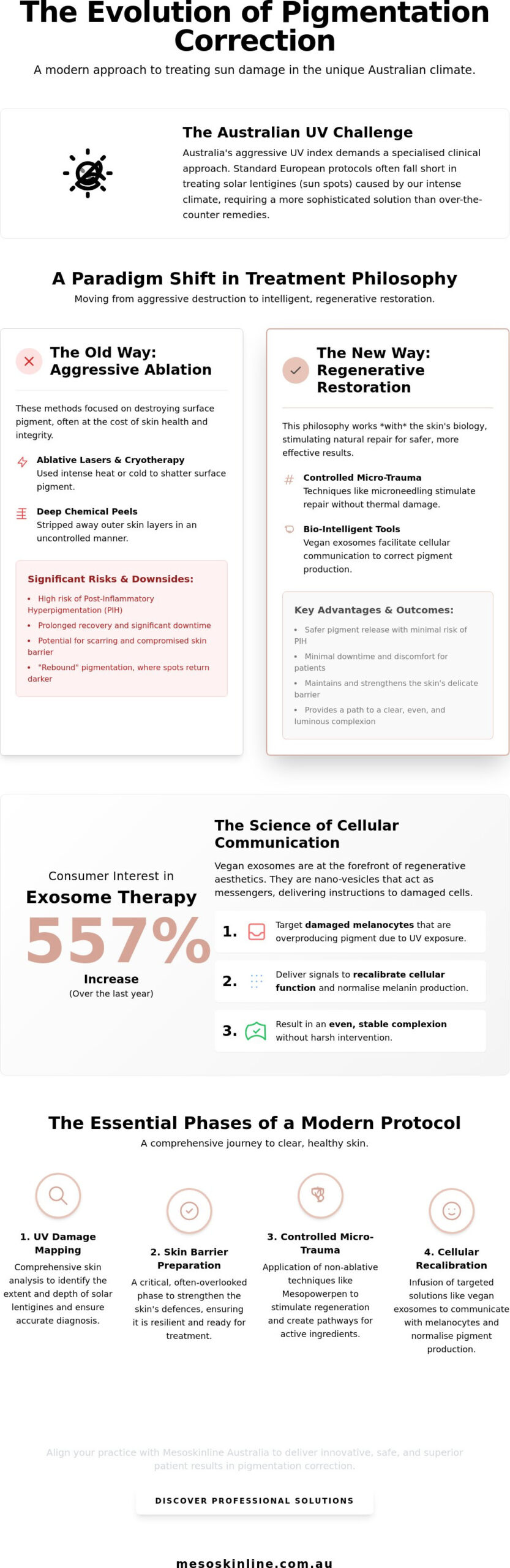
Aesthetic medicine has undergone a significant transformation. For decades, the standard approach to solar damage relied on aggressive destruction: think cryotherapy, deep chemical peels, or ablative lasers. While these methods were effective at removing surface pigment, they often left the skin compromised. The risks included prolonged redness, scarring, and the dreaded “rebound” effect. Today, top-tier Australian clinics have pivoted toward a more sophisticated philosophy. We now prioritise Controlled Micro-Trauma. This method stimulates the skin’s natural repair mechanisms without the scorched-earth policy of traditional thermal treatments.
Modern practitioners are increasingly opting for biocompatible solutions. These protocols work in harmony with the skin’s biological processes rather than fighting against them. When seeking a professional solution for sun spots on face, patients now demand results that don’t require weeks of hiding away. The shift from ablative to non-ablative mesotherapy represents a major leap in safety. By focusing on deep-layer cellular communication, we can achieve a luminous complexion with minimal downtime. It’s a refined, expert-led narrative that values the sensory experience of premium skincare as much as the clinical outcome.
Laser vs. Microneedling for Sun Spots
Traditional lasers rely on heat to shatter pigment. This thermal energy is effective but carries a distinct risk: Post-Inflammatory Hyperpigmentation (PIH). For patients with darker skin types, the heat can actually trigger more melanin production. This is where microneedling excels as a mechanical alternative. It avoids the thermal risk entirely. By creating precise micro-channels, it encourages the skin to shed damaged cells naturally. These channels also serve as direct pathways for high-potency actives to reach the melanocytes.
The Role of Specialised Pigmentation Serums
The “bleaching” creams of the past have been replaced by multi-faceted clinical cocktails. Modern pigmentation solutions utilise a synergy of ingredients like Tranexamic Acid, Niacinamide, and Hexylresorcinol. Each active targets a different stage of the melanin pathway. Hexylresorcinol, for instance, is a potent tyrosinase inhibitor, while Niacinamide prevents the transfer of pigment to the skin’s surface. This layered approach ensures a comprehensive professional solution for sun spots on face that addresses both current spots and future formation. If you’re ready to transition to these advanced protocols, exploring the range at Mesoskinline Australia is an excellent starting point for any clinical practice.
Next-Gen Solutions: Vegan Exosomes and Cellular Communication
The era of aggressive chemical bleaching and destructive cryotherapy is rapidly ending. While older protocols relied on hydroquinone or extreme cold to strip away pigment, modern aesthetic science has found a more elegant path. Vegan exosomes represent the new frontier in skin rejuvenation. These microscopic extracellular vesicles act as bio-intelligent messengers, carrying vital proteins and growth factors directly to compromised cells. In the context of Australian sun damage, they offer a level of precision that traditional topicals simply cannot match. By addressing the skin at a molecular level, they provide a sophisticated professional solution for sun spots on face that prioritises long-term health over temporary fixes.
Sun-damaged skin is essentially skin in a state of chronic inflammation. Traditional treatments often add to this inflammatory load, risking rebound pigmentation. Exosome therapy flips this narrative. These nanoparticles possess profound anti-inflammatory properties that soothe the dermal environment while simultaneously recalibrating overactive melanocytes. For clinics, adopting this biotech breakthrough is a strategic move. It positions a practice at the intersection of medical science and luxury aesthetics, offering a “secret weapon” for patients who have exhausted traditional options without success.
How Exosomes Target Hyperpigmentation
The signaling process is the core of exosome efficacy. When infused into the skin, exosomes deliver specific instructions to melanocytes, effectively “telling” them to slow down the production of melanin. This isn’t a forced chemical suppression but a biological recalibration. The synergy between microneedling and exosome absorption is critical. By using a device like the Mesopowerpen to create precise micro-channels, practitioners ensure these messengers reach the deeper layers where pigment clusters reside. Plant-derived exosomes offer a superior safety profile compared to animal-based alternatives, ensuring high-tier outcomes without the risk of adverse immune responses.
The “Brightening” Protocol of 2026
A typical clinical session in 2026 has evolved into a streamlined, high-efficacy experience. It begins with professional skin mapping, followed by a controlled microneedling phase to prime the tissue. The exosome infusion then follows, allowing the nanoparticles to flood the micro-channels and begin their cellular dialogue. Patients can expect a visible transformation that goes beyond mere spot reduction. The result is a luminous, even complexion with improved texture and a “lit-from-within” quality that traditional peels often fail to achieve. Vegan exosomes represent the pinnacle of non-invasive cellular repair, bridging the gap between clinical efficacy and a premium sensory experience. This advanced professional solution for sun spots on face ensures that Australian patients can achieve an even skin tone with maximum safety and minimal downtime.
A Professional Protocol for Sun Spot Removal
Achieving a clear, luminous complexion requires more than a single clinical appointment. It demands a structured, four-phase journey that respects the skin’s biological limits. While many competitors focus on surface-level exfoliation, a truly effective professional solution for sun spots on face addresses both the visible pigment and the underlying cellular health. This holistic approach ensures results are not just immediate but sustainable in the harsh Australian climate.
Phase 1 begins with comprehensive skin analysis and UV damage mapping. We identify the depth of the solar lentigines before any active treatment starts. Phase 2 focuses on preparing the skin barrier with clinical-grade antioxidants. This step is vital to stabilise the skin and prevent inflammatory responses that could lead to rebound pigmentation. Only once the skin is resilient do we move to Phase 4: the active treatment phase. This involves the precise delivery of actives using tools like the Mesopowerpen. Finally, Phase 4 addresses post-treatment recovery and the “Golden Rule” of Australian SPF. Broad-spectrum protection is a non-negotiable daily requirement to protect your clinical investment.
The Precision of the Mesopowerpen
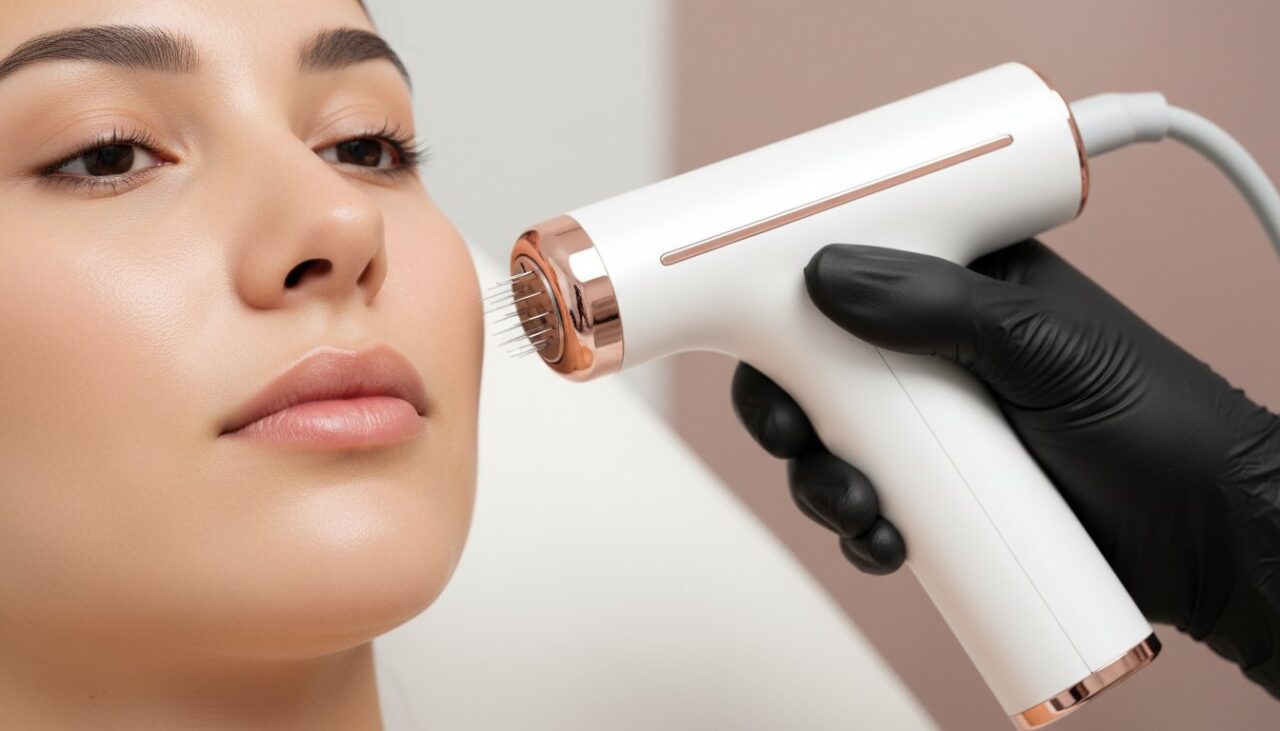
Digital precision is the hallmark of modern microneedling. The Mesopowerpen allows for adjustable needle depth, which is essential when targeting the varying thicknesses of facial skin. This customisation reduces unnecessary trauma and significantly improves patient comfort. Clinical safety is maintained through sterile, single-use cartridges, ensuring a hygienic environment for every session. By controlling the depth of delivery, we can ensure that pigmentation solutions reach the exact layer where melanocytes are overactive. This level of accuracy is what separates professional protocols from at-home attempts.
Home Care Maintenance: Extending Clinical Results
The work doesn’t end when you leave the clinic. A tailored home regime is essential to maintain your results and prevent new spots from forming. We recommend integrating high-performance products like Boto Xtreme to refine texture and specialised pigmentation serums to inhibit future melanin production. Adopting an Australian sun-safe mindset is a lifelong commitment. It’s about protecting the integrity of your skin every day. For practitioners looking to elevate their service offering with these advanced protocols, you can explore our clinical range to ensure your clinic remains at the forefront of aesthetic innovation.
Elevating Your Clinic with Mesoskinline Australia
Mesoskinline Australia serves as the exclusive APAC hub for Danish clinical excellence. We are more than a supplier; we are a dedicated partner in your clinic’s transformation. Australian practitioners face a unique set of challenges due to our extreme UV levels. Providing an effective professional solution for sun spots on face requires tools that are both innovative and rigorously tested. We bridge the gap between sophisticated European science and the pragmatic needs of the local aesthetic market, ensuring your clinic stays ahead of global trends.
Success in a competitive aesthetic environment relies on two pillars: superior patient outcomes and business profitability. Our systems are designed to deliver both. By integrating our protocols, practitioners can reduce treatment times without compromising on the sensory experience or clinical results. This efficiency translates directly to a more viable commercial model. It’s a visionary approach that values the practitioner’s expertise while promising high-tier outcomes to the end consumer.
Education is at the core of our professional partnership. Through our advanced facial courses, we ensure your team is proficient in the most current 2026 techniques. We also provide the marketing assistance needed to communicate these premium results to your clientele. This comprehensive support system is why leading Australian clinics trust our heritage of quality for their pigmentation correction protocols.
Why Practitioners Choose Our Pigmentation Solutions
Our pigmentation solutions are defined by their rigorous testing and European heritage. Every formulation is crafted to meet international clinical standards, ensuring safety and efficacy for every skin type. These products integrate seamlessly into existing clinic menus, allowing for a smooth transition to more advanced treatments. For clinics across the country, our mesotherapy supplies Australia are available for reliable national delivery, ensuring you never face a disruption in service.
Join the Future of Australian Skin Health
The consumer of 2026 is highly discerning. They increasingly seek low-downtime, non-invasive alternatives to traditional surgery. Upgrading your technology to meet these demands isn’t just about keeping up; it’s about establishing your clinic as an industry leader. By offering a refined professional solution for sun spots on face, you address the growing demand for “skin health over hype.” We invite you to explore a partnership that prioritises clinical excellence and visible transformation. Join us in shaping the future of Australian aesthetic medicine through precision, safety, and a commitment to results.
Embracing the Future of Australian Skin Correction
The transition from aggressive, heat-based modalities to sophisticated cellular communication marks a new era for Australian aesthetic practices. By moving beyond surface-level destruction and embracing tools like vegan exosomes and the Red Dot Design Award-winning Mesopowerpen, practitioners can finally offer a reliable professional solution for sun spots on face. This shift ensures that patients achieve the luminous, even complexion they desire without the risks associated with traditional ablative lasers. It’s about combining clinical precision with a deep understanding of the skin’s biological repair pathways.
As the exclusive APAC distributor of Danish clinical technology, Mesoskinline Australia provides the expertise and systems needed to elevate your clinic’s standards. We’re proud to be trusted by leading Australian aesthetic practitioners who value both patient safety and business profitability. You can Discover our professional pigmentation correction range at Mesoskinline Australia and begin offering the next generation of skin health today. The journey to restoring a radiant complexion is now more precise, safe, and effective than ever before.
Frequently Asked Questions
How many professional sessions are needed to remove sun spots on the face?
Most patients require between three and six professional sessions to achieve visible clearance of solar lentigines. The exact number depends on the depth of the pigment and your skin’s unique regenerative speed. Your practitioner will use a staged approach to ensure the skin remains resilient throughout the process. Ongoing maintenance is essential to sustain these results in the Australian climate.
Is microneedling better than laser for Australian sun damage?
Microneedling is often preferred over laser for Australian skin because it avoids the risk of heat-induced hyperpigmentation. Traditional lasers rely on thermal energy which can trigger a defensive melanin response in some skin types. Using a device like the Mesopowerpen provides a mechanical alternative that creates micro-channels without excessive heat. This makes it a safer, more versatile professional solution for sun spots on face.
Can sun spots on the face be permanently removed?
Existing sun spots can be effectively cleared through clinical protocols; however, the skin’s memory remains. While a specific spot may be eliminated, new areas of hyperpigmentation can develop if the skin is subjected to further UV damage. Permanent results require a combination of professional correction and a lifelong commitment to high-SPF broad-spectrum protection to prevent future melanocyte overactivity.
What is the difference between a sun spot and a mole?
Sun spots are flat, pigmented patches known as solar lentigines that develop due to cumulative UV exposure. Moles are typically darker and can be raised or flat; they are clusters of pigmented cells that may be present from birth or develop later. It’s vital to have any new or changing spots assessed by a professional to rule out more serious conditions like lentigo maligna before starting aesthetic treatments.
Are vegan exosomes safe for all skin types?
Vegan exosomes are exceptionally safe for all skin types due to their bio-identical and non-immunogenic nature. Because they are plant-derived, they carry a lower risk of adverse reactions compared to animal-based vesicles. They act as precise messengers to recalibrate skin cells without causing irritation. This makes them an ideal component of a professional solution for sun spots on face for those with sensitive or reactive complexions.
How long is the downtime after a professional pigmentation treatment?
Most patients experience minimal downtime, typically lasting between 24 and 48 hours. You might notice a slight redness or a sensation similar to a mild sunburn immediately after the session. This quickly subsides as the skin’s repair mechanisms are activated. Most individuals return to their regular social activities within two days, provided they adhere to strict post-treatment sun safety protocols.
What is the best professional ingredient for fading dark spots?
Tranexamic acid and hexylresorcinol are currently considered the gold standards in clinical pigmentation correction. These ingredients work by inhibiting the tyrosinase enzyme and blocking the pathways that lead to melanin transfer. When combined with niacinamide in specialised pigmentation solutions, they offer a comprehensive approach to fading dark spots. These actives are far more effective when delivered via professional modalities than through surface-level retail creams.
Can I treat sun spots at home with professional-grade serums?
Professional-grade serums are designed to maintain and extend the results achieved in a clinic rather than replace them. While high-potency home care is essential for preventing new damage, it lacks the delivery systems needed to reach deep-seated pigment clusters. True correction requires clinical tools to bypass the skin barrier safely. Use home regimes to support the work done by your practitioner for the best long-term outcome.


Stay in the Glow
Get skincare tips and early access to new products.
