
A premium aesthetic device is more than a clinical tool; it’s a financial commitment that can either anchor your practice or propel it toward a 500% ROI. While the allure of the latest technology is strong, calculating ROI on new aesthetic equipment requires a clinical eye for detail that goes far beyond the initial sticker price. You’re likely balancing the pressure of high upfront costs against the need for TGA-compliant, “no downtime” solutions that keep your treatment rooms turning over. We know the weight of choosing between entry-level diode lasers and A$150,000 premium platforms is significant when interest rates for qualified borrowers sit between 5% and 18% in 2026.
This guide provides the sophisticated financial blueprint you need to secure a predictable, scalable revenue stream. You’ll master the metrics required to ensure your next investment drives both clinical excellence and sustainable growth. We’ll analyse current benchmarks for body contouring and skin rejuvenation; explore how to compress your break-even timeline to under 18 months; and reveal why the philosophy where Science Meets Luxury is the ultimate formula for patient retention and visible transformation.
Key Takeaways
- Look beyond the initial purchase price to evaluate the total cost of ownership, ensuring your investment aligns with long-term operational profitability.
- Master a precise framework for calculating ROI on new aesthetic equipment by factoring in landed costs, TGA compliance, and realistic treatment volumes.
- Maximise clinic revenue by prioritising “no downtime” technologies that increase room turnover and eliminate the high cost of idle treatment spaces.
- Identify hidden variables such as consumable margins and the superior resale value associated with European manufacturing standards and clinical durability.
- Implement a turnkey business model that balances clinical precision with high-end luxury to secure a predictable and scalable revenue stream for your practice.
The Strategic Importance of Calculating ROI in Modern Aesthetic Practice
In the high-stakes environment of 2026 aesthetics, financial intuition is no longer enough to sustain a growing practice. To thrive, you must adopt a rigorous approach to Return on Investment (ROI), which we define as the ratio between your net profit and the total cost of your investment over a specific period. Many practitioners fall into the trap of viewing a new device solely through the lens of its purchase price. However, calculating ROI on new aesthetic equipment requires a broader perspective that encompasses long-term operational costs and clinical efficacy. When science meets luxury, your clinic transitions from a commodity service to a premium destination. This shift justifies higher margins and ensures your business remains financially sustainable while delivering gold-standard results. Clinical excellence isn’t just a medical goal; it’s the primary engine of your profitability.
Distinguishing Between CAPEX and OPEX
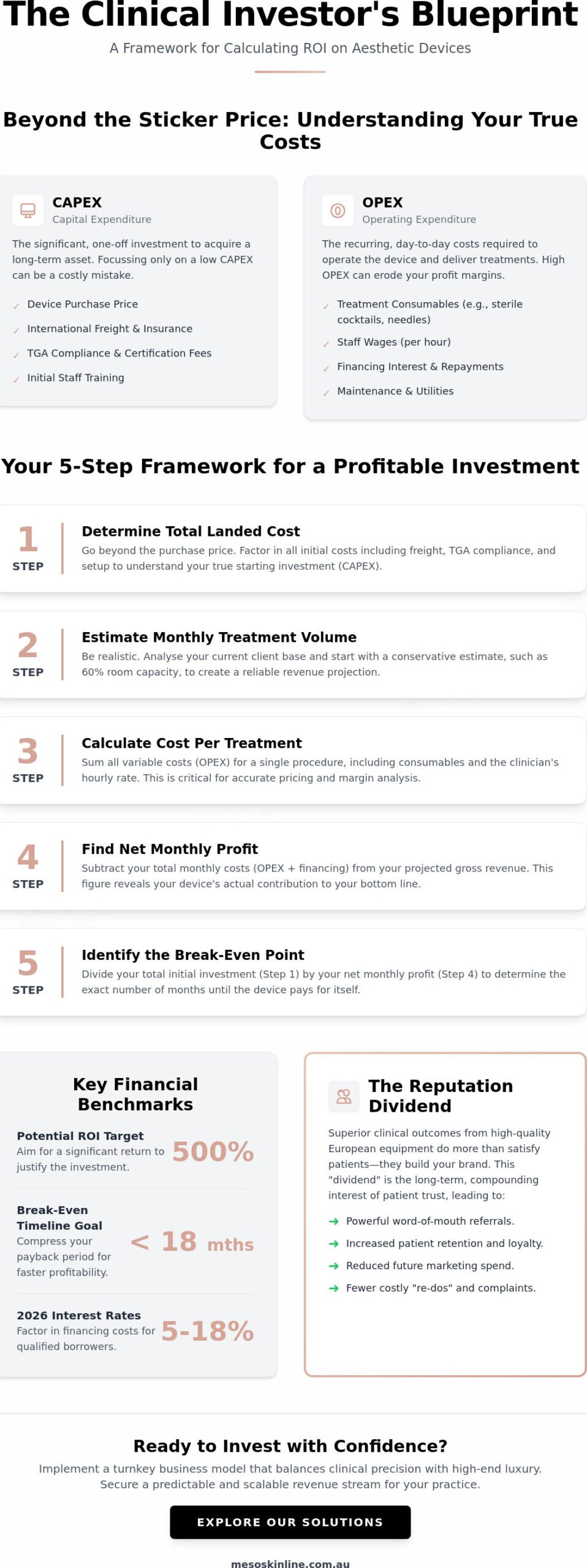
Successful Australian clinics separate Capital Expenditure (CAPEX) from Operating Expenditure (OPEX) to avoid the “price trap.” CAPEX represents the initial investment in the machine itself, such as a high-end platform for mesotherapy or skin rejuvenation. OPEX includes the ongoing costs required to perform each treatment: sterile cocktails, vegan exosomes, needles, and even electricity. If you focus only on a low CAPEX, you might overlook exorbitant consumable costs that eat into your daily margins. Amortisation plays a critical role here. It allows you to spread the cost of the equipment over its useful life, providing a clearer picture of your yearly profit statements and tax obligations. This transparency ensures you aren’t surprised by hidden expenses three years into a five-year finance plan, allowing you to maintain a healthy cash flow for future expansions.
The Reputation Dividend: ROI Beyond the Balance Sheet
Financial metrics often miss the intangible value of clinical precision. Investing in high-quality European equipment, such as the Mesopowerpen, reduces the frequency of patient complaints and costly “re-dos” that drain your staff’s time. Superior clinical outcomes naturally generate word-of-mouth referrals, which are the most cost-effective way to grow your patient base in a competitive Australian market. When a treatment delivers visible transformation with no downtime, patient trust compounds. The Reputation Dividend is the long-term compounding interest of patient trust. By prioritising equipment that offers safety and efficacy, you’re investing in a brand that patients will return to for years, effectively lowering your future marketing spend while securing a loyal, high-value clientele.
A Step-by-Step Framework for Calculating ROI on Aesthetic Devices
Precision in the treatment room must be matched by precision on the balance sheet. While digital calculators offer a quick glimpse, a manual audit provides the granular insight required for a visionary clinic owner. When calculating ROI on new aesthetic equipment, you aren’t just looking for a short-term win; you’re assessing long-term profitability through a lens of clinical reliability and patient satisfaction. Follow this five-step framework to determine the true financial viability of your next acquisition.
- Step 1: Determine the total landed cost. This includes the purchase price (CAPEX), international freight to Australia, TGA compliance fees, and the initial training sessions for your clinicians.
- Step 2: Estimate conservative monthly treatment volume. Analyse your current patient demographics. How many existing clients are actively seeking solutions for pigmentation or hair loss? Start with a conservative 60% capacity estimate.
- Step 3: Calculate the “Cost Per Treatment.” Sum the cost of all consumables, such as sterile cocktails and needles, and add the hourly rate of the staff member performing the procedure.
- Step 4: Find your net monthly profit. Subtract your total monthly expenses (OPEX and financing interest) from your projected gross revenue.
- Step 5: Identify the break-even point. Divide your total initial investment by your net monthly profit to see exactly how many months it will take to pay off the device.
Setting Realistic Treatment Pricing
Researching the Australian market is essential to ensure your pricing reflects a premium “Science Meets Luxury” positioning. Avoid the temptation to underprice; “cheap” treatments often fail to cover their own OPEX and can devalue your brand. Instead, consider package pricing for five or ten sessions. This strategy boosts immediate cash flow and secures patient commitment, ensuring they complete the full protocol for visible transformation. If you’re unsure where to start, exploring Mesoskinline’s range of medical-grade devices can provide a benchmark for high-margin service models.
Projecting Your Break-Even Timeline
A healthy break-even period varies significantly by technology. While a A$150,000 laser platform might take 18 to 24 months to reach profitability, a professional microneedling device often pays for itself within three to six months due to its lower initial CAPEX. Always account for a “ramp-up” phase of 30 to 60 days. This allows your team to gain confidence with the new clinical protocols before you hit peak treatment volume. By choosing devices with lower entry costs but high clinical efficacy, you can achieve a faster ROI and reinvest those profits back into your clinic’s growth.
Hidden Variables: Consumables, Downtime, and Room Utilisation
While the initial framework provides a robust foundation, the true mastery of calculating ROI on new aesthetic equipment lies in identifying the variables that don’t appear on a standard invoice. In the high-pressure environment of a modern Australian clinic, every minute a treatment room sits idle represents a missed opportunity for revenue. We call this the “Cost of a Closed Room.” If your equipment requires lengthy setup times or frequent maintenance, your effective hourly rate plummets. Conversely, utilising pre-mixed, sterile cocktails allows for immediate procedure commencement; reducing preparation time and eliminating the waste associated with hand-mixing ingredients. This operational efficiency ensures that your room turnover remains high, directly impacting your bottom line.
Reliability is another silent driver of profitability. Equipment with a European heritage, specifically from Denmark or Italy, is built to rigorous clinical standards that minimise the risk of technical failure. Unreliable, non-European devices often become “ROI killers” due to frequent servicing requirements and the subsequent loss of bookings. In 2026, savvy clinic owners recognise that the total cost of ownership can exceed the initial purchase price by 50% to 100% over a five-year period if consumables and maintenance aren’t tightly controlled. Choosing a system designed for longevity isn’t just a quality choice; it’s a strategic financial one.
The True Cost of Consumables
The margin on each treatment is dictated by the quality and efficiency of your supplies. Generic needles and serums may seem cost-effective initially, but they often lead to inconsistent results and higher wastage. Investing in premium mesotherapy supplies Australia ensures that every drop of product is utilised effectively. High-quality systems like the Mesopowerpen use “no-waste” packaging for their clinical serums, allowing you to maintain precise inventory control. This level of detail ensures your margins remain protected, even as the cost of clinical goods fluctuates in the Australian market.
Maximising Room Turnover
Efficiency is the cornerstone of a scalable revenue stream. Consider the math of a 45-minute treatment window: saving just 10 minutes per patient through streamlined protocols adds up to over eight hours of reclaimed time each week. That’s enough space for an entire extra day of bookings. Furthermore, the “No Downtime” advantage is your most potent marketing tool. By providing “luxury results” that allow patients to return to their daily lives immediately, you increase the lifetime value of each client. They’re more likely to book regular maintenance sessions, transforming a one-off treatment into a predictable, recurring income stream for your practice.
Assessing Performance vs. Long-Term Profitability
The cheapest machine on the market often hides a mountain of operational debt. When calculating ROI on new aesthetic equipment, you must look beyond the initial invoice to the Total Cost of Ownership (TCO). A device that saves you A$5,000 upfront but requires proprietary consumables with low margins will eventually cost you more than a premium European platform. High-end devices from Denmark and Italy don’t just offer superior clinical results; they’re engineered for longevity. While a budget import might depreciate by 90% within its first two years, premium, TGA-compliant brands typically retain 40-60% of their value after three years. This resale potential is a critical, yet often ignored, component of your long-term financial health.
Versatility acts as a force multiplier for your revenue. A device that only treats one concern limits your room utilisation; however, a platform capable of addressing hair loss, pigmentation, and ageing ensures your calendar remains full. Turnkey business models accelerate your ROI curve by providing the clinical protocols and marketing assets needed to launch a new service instantly. You aren’t just buying a machine; you’re investing in a system that’s ready to generate profit from day one. Choosing a partner that offers this level of support ensures your clinic can adapt to the projected 18.8% market growth through 2030.
Quality vs. Quantity in Aesthetic Tech
The Australian regulatory environment is increasingly strict regarding medical device compliance. Using non-compliant or “off-label” equipment carries significant financial risks, including potential fines and the loss of professional indemnity insurance. In contrast, “Trusted by Professionals” isn’t just a slogan; it’s a metric that translates into patient confidence and repeat bookings. Premium European devices ensure consistent fibroblast activation and precise delivery of sterile cocktails, reducing the likelihood of adverse events that could damage your clinic’s reputation and bottom line.
The Multi-Treatment Benefit
Increasing your Average Transaction Value (ATV) is the fastest way to boost profitability without increasing your marketing spend. Advanced devices allow for seamless “add-on” services, such as applying a specialised Eyelift serum or Lip volume serum during a standard mesotherapy session. To maximise these opportunities, your staff must be experts in device utility. Enrolling your team in advanced facial courses ensures they can confidently cross-sell treatments and deliver the “luxury results” your clients expect. To explore how a versatile equipment range can transform your practice, view our full clinical collection.
Maximising Returns with the Mesoskinline Turnkey Model
At the intersection of medical science and luxury aesthetics, the Mesoskinline turnkey model offers a complete system for success. It’s a visionary approach that simplifies calculating ROI on new aesthetic equipment by removing the guesswork from clinical implementation. Our “Science Meets Luxury” philosophy isn’t just a mantra; it’s a rigorously tested business model designed to instill trust in your practitioners while delivering visible transformation to your patients. With exclusive APAC distribution rights and a heritage of European quality from Denmark and Italy, we provide the credibility your clinic needs to command premium rates in the Australian market. Every product we distribute is chosen for its ability to deliver “No Downtime · Higher ROI,” ensuring your treatment rooms remain active and your margins remain high.
Beyond the Machine: Training and Support
Clinical training is the best insurance policy for your equipment investment. A device only generates profit when your staff are confident, precise, and “salon-ready.” We provide exhaustive, TGA-compliant protocols that reduce implementation time from weeks to just a few days. This rapid deployment is essential for clinics looking to capture immediate demand for new treatments like vegan exosomes or hair loss control. Marketing support ensures your new acquisition doesn’t sit idle; instead, it becomes a focal point of your clinic’s growth strategy. By bridging the gap between technical specification and commercial application, we ensure your investment starts paying for itself from the very first booking.
The Synergy of Devices and Cocktails
The true power of our model lies in the synergy between our medical-grade devices and sterile cocktails. When you pair the Mesopowerpen with Boto Xtreme serum or our specialised pigmentation solutions, you aren’t just performing a treatment; you’re delivering a “gold standard” result with no downtime. This combination maximises patient satisfaction and ensures high retention rates, which are the lifeblood of a sustainable practice. We’ve streamlined our Australian supply chains to reduce your overheads and eliminate the waste often found in generic systems. This precision in supply ensures that your cost per treatment remains predictable and your profit margins stay protected. Discover how to elevate your clinic’s profitability with our advanced aesthetic solutions.
Success in 2026 requires more than just a machine; it requires a partnership grounded in clinical authority. If you’re ready to master your financial metrics and ensure long-term clinical excellence, we’re here to guide you. Our team understands the unique pressures of the Australian aesthetic market, from TGA compliance to room turnover efficiency. Book a consultation with us today for a bespoke ROI projection tailored to your clinic’s specific demographics and treatment capacity. Let’s build a predictable, scalable revenue stream together.
Transforming Clinical Precision into Sustainable Growth
The evolution of the Australian aesthetic market through 2030 demands a sophisticated shift from simple purchasing to strategic investment. We’ve explored how calculating ROI on new aesthetic equipment requires a deep analysis of room utilisation, consumable margins, and the specific “No Downtime · Higher ROI” protocols that keep your treatment rooms active. By prioritising European heritage from Denmark and Italy, you ensure your clinic benefits from the 40-60% resale value typical of premium, TGA-compliant platforms. These metrics represent the difference between a device that merely functions and a system that scales your profitability.
Success is ultimately found where science meets luxury. When you implement a comprehensive turnkey model, you reduce the initial ramp-up phase and secure the reputation dividend that comes from being trusted by leading Australian practitioners. It’s time to move beyond the balance sheet and build a legacy of clinical excellence that prioritises both patient outcomes and business health. We invite you to Request Your Bespoke ROI Consultation and Equipment Guide to discover how our precision systems can scale your revenue. Your journey toward a more profitable, visionary practice starts with a single, informed decision today.
Frequently Asked Questions
How long should it take for a new aesthetic device to pay for itself?
A healthy payback period typically ranges from 12 to 24 months for larger platforms, while smaller clinical tools often pay for themselves within 3 to 6 months. For instance, laser hair removal systems average a 12 to 18 month payback period. When calculating ROI on new aesthetic equipment, you should aim for a break-even point that aligns with your cash flow requirements without sacrificing the “Science Meets Luxury” patient experience.
Is it better to lease or buy aesthetic equipment for the best ROI?
The choice depends on your clinic’s capital strategy and tax position. Leasing preserves cash flow and allows for easier technology upgrades every 3 to 5 years, which is vital in a rapidly evolving market. However, purchasing builds equity and often results in a higher long-term ROI by eliminating ongoing interest costs. Consult with your financial advisor to determine which model maximises your A$ depreciation benefits under current Australian tax laws.
What are the most common hidden costs when purchasing new clinic tech?
Consumables and maintenance are the most significant hidden variables. While the initial price is prominent, the ongoing cost of sterile cocktails, needles, and specialised serums can exceed the purchase price by 100% over five years. Other often overlooked expenses include TGA compliance fees, staff training time, and the “cost of a closed room” during technical servicing. Reliable European manufacturing standards help mitigate these unpredictable costs through superior clinical durability.
How does patient downtime affect my clinic’s bottom line?
Patient downtime directly limits your room turnover and total weekly revenue. Treatments that require significant recovery time prevent patients from booking frequent maintenance sessions, which reduces their total lifetime value to your clinic. By prioritising “No Downtime · Higher ROI” protocols, you can increase treatment frequency and maintain a steady, predictable revenue stream. Patients in 2026 increasingly demand luxury results that don’t interrupt their professional or social calendars.
Can I calculate ROI if I am offering a completely new service?
Yes, you can estimate this by using conservative volume projections based on your existing patient demographics. Start by assuming a 60% room capacity and research local Australian market rates to set a premium yet competitive price point. Calculating ROI on new aesthetic equipment for a new service requires factoring in a 30 to 60 day “ramp-up” phase where your staff gain clinical confidence and your marketing efforts begin to convert.
What is the “Cost Per Treatment” and why is it more important than the purchase price?
Cost Per Treatment is the total expense of consumables and staff time required for a single procedure. It’s the most critical metric because it determines your daily net margin. A machine with a low upfront cost often uses expensive, proprietary cartridges that eat into your profits. Focusing on the daily margin rather than the sticker price ensures your clinic remains financially sustainable while delivering gold-standard results like fibroblast activation.
How do European clinical standards impact my long-term profitability?
European standards from Denmark and Italy ensure higher device reliability and better clinical outcomes. Devices built to these standards typically retain 40% to 60% of their resale value after three years, compared to just 10% for budget imports. This longevity reduces the frequency of “re-dos” and patient complaints. This clinical authority translates directly into a “Reputation Dividend” that drives high-value word-of-mouth referrals across your Australian patient base.
Does the TGA status of a device affect its potential ROI?
TGA status is a mandatory requirement that protects your clinic from significant legal and financial risks. Operating non-compliant equipment can lead to heavy fines and the immediate cancellation of your professional indemnity insurance. Beyond safety, TGA-cleared devices hold their value better in the Australian secondary market. Ensuring your tech is fully compliant is the only way to guarantee a secure, long-term ROI that supports sustainable clinic growth.

Stay in the Glow
Get skincare tips and early access to new products.
