

The most sophisticated tool in your treatment room isn’t your latest laser; it’s the strategic framework of your initial assessment. As the Australian medical aesthetics market scales toward a projected USD 784.8 million by 2034, the distinction between a standard appointment and a clinical masterclass is vital. Implementing client consultation best practices for skin treatments is no longer a soft skill. It’s a rigorous diagnostic necessity that bridges the gap between scientific rigor and premium patient experiences.
You’ve likely felt the frustration of a client declining a high-value treatment plan or the anxiety of managing inconsistent results from advanced modalities. It’s a common challenge in an era where AHPRA’s 2026 guidelines mandate deeper assessments and strict 1mm depth limits for non-medical practitioners. This guide will empower you to master a professional consultation framework that ensures patient safety while driving clinic profitability through higher uptake of advanced serums and devices. We’ll examine the essential regulatory shifts, from the July 2026 UDI deadline to the new public health framework for microneedling, providing you with a complete system for clinical success.
Key Takeaways
- Learn how to transition from basic intake to a bespoke patient journey that synthesises clinical diagnostics with long-term skin health goals.
- Implement a rigorous 5-step clinical assessment framework covering history, analysis, objective, plan, and consent to ensure patient safety and meet current Australian regulatory standards.
- Discover how to integrate digital diagnostic tools to justify treatment parameters for precision devices, ensuring every clinical decision is backed by data.
- Master client consultation best practices for skin treatments by adopting an education-first model that builds trust and naturally increases the uptake of high-value treatment plans.
- Optimise your clinic’s commercial viability by standardising professional consultation systems across your team to ensure brand consistency and measurable conversion growth.
The Evolution of Client Consultation in the Australian Aesthetic Market
The Australian aesthetic landscape has undergone a profound transformation. It’s no longer enough to offer a menu of services; practitioners must now provide a sophisticated synthesis of clinical diagnostics and bespoke patient journey mapping. This shift is driven by a more discerning clientele and a regulatory environment that demands higher standards of care. Adopting client consultation best practices for skin treatments is the only way to ensure your clinic remains competitive in a market projected to reach USD 784.8 million by 2034.
A “one-size-fits-all” approach is destined to fail in Australia. Patients here are highly informed and expect personalised strategies that address their specific biological needs. By transitioning from a service provider to a trusted clinical authority, you’re establishing a relationship based on expertise rather than transactions. This transition begins with a comprehensive guide to skin care that integrates medical history with lifestyle analysis. When you conduct a thorough intake, you aren’t just gathering data; you’re building the foundation for a clinical outcome that is both safe and transformative.
Consultation as a Risk Management Tool
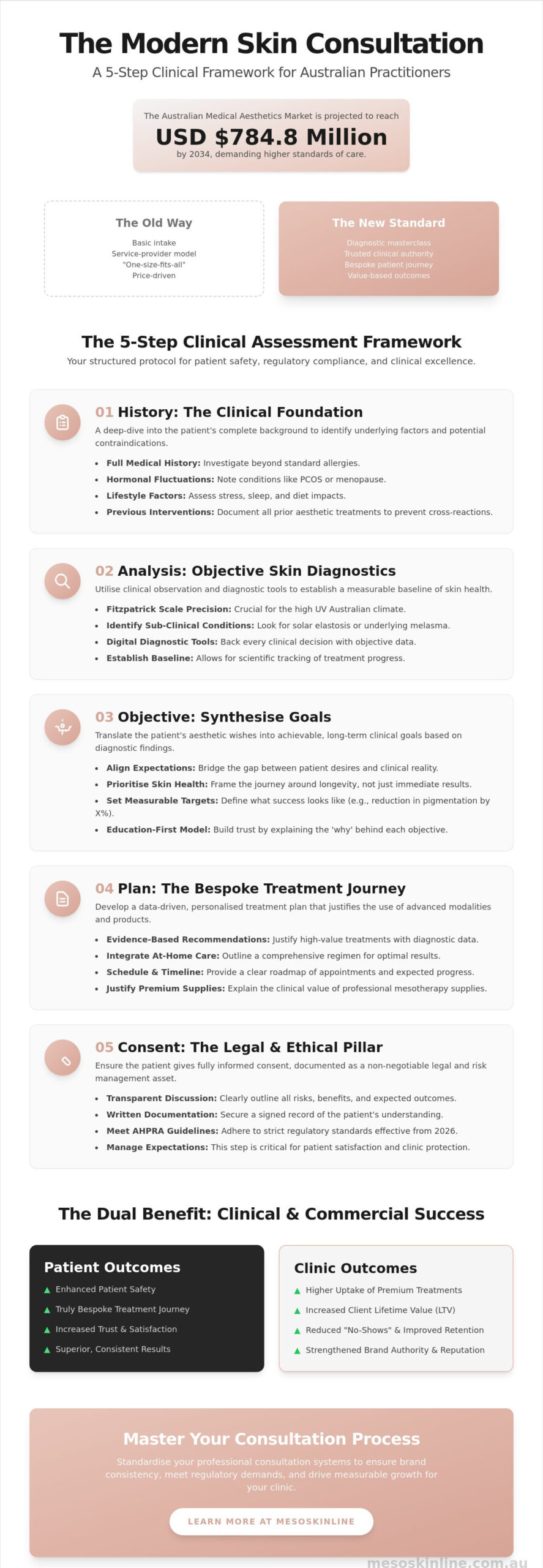
In 2026, the consultation serves as your most critical risk management asset. It’s the primary mechanism for identifying contraindications before applying high-performance serums such as Boto Xtreme. Under the AHPRA guidelines effective from late 2025, informed consent is a non-negotiable legal pillar. You must document that the patient understands the risks, benefits, and expected outcomes of advanced modalities. Establishing a baseline of skin health through objective analysis allows you to track progress with scientific precision, which is essential when managing patient expectations for procedures like skin needling where depth limits are now strictly regulated.
The Business Case for Extended Consultations
Professionalism pays dividends. A dedicated 30-minute diagnostic session significantly increases the lifetime value of a client by establishing a deep clinical connection early. This professional rapport reduces “no-shows” and builds the trust necessary for high-value commitments. A detailed assessment provides the clinical evidence needed to justify the use of premium mesotherapy supplies Australia. When you use client consultation best practices for skin treatments, you move away from price-driven conversations and toward value-based outcomes. Your patients aren’t just buying a serum; they’re investing in a scientifically validated plan for skin longevity and health.
Clinical Assessment Protocols: Best Practices for Patient Safety
A rigorous clinical assessment is the cornerstone of modern aesthetic practice. It moves the conversation beyond a simple aesthetic wish-list into a formal risk-management protocol. To achieve excellence, practitioners must adopt a 5-step framework: History, Analysis, Objective, Plan, and Consent. This structured approach ensures that no detail is overlooked; it transforms the initial meeting into a high-level diagnostic event. Integrating these client consultation best practices allows you to identify potential complications long before a device touches the skin.
A deep-dive into medical history is essential. You must look beyond standard allergies to investigate hormonal fluctuations, such as those associated with PCOS or menopause, and lifestyle factors like high-stress levels or sleep deprivation. These elements directly dictate the skin’s regenerative capacity. In the context of the Australian climate, assessing the Fitzpatrick scale requires extreme precision. High UV exposure levels in cities like Brisbane or Perth mean that even a Fitzpatrick II may present with significant solar elastosis or sub-clinical melasma. Documenting every previous aesthetic intervention is also vital. This prevents the risk of over-treating the tissue or causing adverse cross-reactions between different product chemistries. The Safety-First protocol represents the mandatory clinical baseline for all Australian dermal clinicians; it is a systematic commitment to risk mitigation that precedes every aesthetic intervention.
Analysing Lifestyle and Environmental Factors
The Australian environment is notoriously harsh on the skin barrier. You must evaluate how local humidity and UV indices impact a client’s hydration levels and barrier integrity. Many patients suffer from “product fatigue” caused by using too many active ingredients that clash, such as mixing high-strength retinoids with unstable acids. Discussing nutritional habits is equally important. Diets high in processed sugars can lead to glycation, which compromises collagen synthesis and hinders the results of your treatments.
The Physical Skin Examination
Precision begins with palpation. Use specific techniques to assess skin turgor, texture, and lipid balance. This tactile feedback reveals more about the skin’s health than a visual check alone. You should also look for underlying vascularity or sub-clinical pigmentation that may not be visible under normal light. Standardised lighting and high-resolution photography are non-negotiable for creating accurate records. These tools allow you to track objective progress and provide the evidence needed to recommend advanced professional clinical training or specialised treatment modalities for your patients.
Integrating Advanced Diagnostic Tools and Technology
Precision diagnostics have redefined the modern clinic. Digital skin analysis no longer serves as a mere visual aid; it is the cornerstone of professional credibility. By utilising multispectral imaging, you can visualise deep-layer pigmentation and vascular irregularities before they manifest on the surface. This proactive approach allows for a level of transparency that traditional magnifying lamps simply cannot provide. Integrating technology into your workflow is central to client consultation best practices for skin treatments, as it provides the empirical data required to justify advanced clinical interventions. AI-driven predictive modeling further enhances this process, allowing you to project treatment outcomes and manage patient expectations with scientific accuracy.
The synergy between diagnostic data and device settings is where clinical excellence is realised. When you align imaging findings with specific microneedling parameters, you eliminate the guesswork often associated with dermal therapies. This data-driven strategy ensures that every pass of the device is purposeful, targeted, and safe. A comprehensive guide to the client consultation emphasises that trust is built through this type of evidentiary support. Patients are more likely to commit to long-term plans when they see the objective evidence of their skin’s internal condition.
Device-Specific Consultations: The Mesopowerpen Protocol
The Mesopowerpen protocol requires a meticulous assessment of epidermal thickness and tissue resilience. You must determine the exact needle depth based on the specific anatomical site and the patient’s unique concerns, ensuring you remain within the 2026 AHPRA limit of 1mm for non-medical practitioners. Selecting the correct meso-serum is equally critical. Whether you’re applying a targeted Eyelift serum for periorbital rejuvenation or utilising vegan exosomes for global repair, the choice must be backed by your initial diagnostic findings. Educating the client on the biological mechanism of action doesn’t just inform; it elevates the perceived value of the procedure.
Bespoke Serum Selection through Diagnostics
Diagnostics allow for the creation of truly bespoke treatment “cocktails.” For clients presenting with compromised healing or advanced chronological ageing, exosome therapy offers a superior regenerative pathway. Targeted pigmentation solutions should be selected based on the specific melanin activity identified during the digital scan. This level of customisation ensures immediate recovery and supports long-term structural repair. By matching the serum’s molecular weight and active concentrations to the skin’s current physiological state, you ensure maximum efficacy and clinical safety.
The Psychology of Conversion: Building Trust and Treatment Plans
Conversion in a high-tier clinic is an exercise in psychological alignment rather than a sales pitch. It requires a shift from transactional interactions to a relational, expert-led dialogue. Masterful client consultation best practices for skin treatments prioritise active listening, where the practitioner moves beyond the superficial question of “what do you want” to the diagnostic “what do you need.” By identifying the underlying emotional drivers behind a client’s concerns, you can tailor a journey that feels deeply personal and clinically justified. This level of empathy, combined with clinical authority, is what separates a premier practitioner from the broader market.
The Education-First model is your most potent tool for increasing treatment uptake. When you explain the cellular science behind a recommendation, the client no longer feels “sold” to; they feel educated. High-end clients in 2026 value transparency and technical depth. By describing how specific ingredients or modalities interact with the skin’s physiology, you build a bridge of trust that makes high-value plans a logical choice. To facilitate this, organise your offerings into a tiered treatment programme: Essential (barrier health), Advanced (corrective), and Ultimate Rejuvenation (long-term longevity). This structure allows clients to choose their level of investment while ensuring they understand the superior outcomes associated with more intensive protocols.
Addressing price objections requires a firm focus on clinical efficacy. When a client asks why your treatment costs more than the salon down the road, your response must highlight the difference between a high-street facial and a medical-grade intervention. Focus on the quality of your formulations, the precision of your devices, and your rigorous safety standards. You aren’t just providing a service; you’re delivering a predictable, scientifically validated result that a standard salon cannot replicate.
Managing Expectations and “The Gap”
Honesty regarding the clinical journey is vital for long-term retention. You must clearly communicate the “gap” between the current state and the desired outcome, including realistic timelines for results. Use clinical data to explain why modalities like radio frequency or needling require multiple sessions to stimulate significant collagen synthesis. The “under-promise and over-deliver” mantra ensures that clients remain satisfied throughout the process, even when visible changes take time to manifest. This transparency prevents frustration and cements your reputation as a visionary expert.
Finalising the Treatment Plan
A professional plan must be organised into clear phases: Preparation, Active Treatment, and Maintenance. This roadmap provides the client with a sense of security and direction. Always provide a written summary and a digital copy of the proposed journey to reinforce the professional nature of the consultation. To ensure clinic profitability and client consistency, aim to secure the next three appointments before the client leaves the room. This commitment reinforces the idea that skin transformation is a process, not a singular event. For those looking to elevate their practice further, seeking professional clinical support can provide the systems needed for seamless conversion.
Optimising Clinic ROI through Professional Consultation Systems
Clinical excellence must be scalable to ensure long-term commercial viability. Standardising the diagnostic process across your entire team is the only way to maintain brand consistency and ensure that every patient receives a premium experience. When every staff member adheres to client consultation best practices for skin treatments, the clinic operates as a unified authority. This systematic approach allows you to track conversion rates with precision, moving from the initial assessment to the uptake of high-value treatment plans. By treating the consultation as a measurable business process, you can identify precisely where potential clients are engaging or where they might be dropping off.
Leveraging advanced facial courses is essential for keeping your team at the forefront of diagnostic innovation. These programmes provide the technical depth required to handle complex patient profiles and sophisticated device parameters. Beyond the initial training, automated follow-up systems play a critical role in maintaining the client relationship. A well-timed, personalised message after a consultation reinforces the clinical bond and provides a bridge to the first active treatment session. It transforms a singular meeting into a continuous journey of care, ensuring that your clinic remains the primary authority for the patient’s skin health.
Training Your Team for Consultation Excellence
Success in the consultation room requires more than technical knowledge; it requires rehearsed professional communication. Role-playing common client objections and clinical scenarios allows staff to handle difficult questions with composure and authority. Implementing a peer-review system for treatment plans ensures that every recommendation meets your clinic’s rigorous standards. Continuous education on emerging ingredients, such as vegan exosomes and advanced peptides, ensures that your team can always justify the use of premium formulations with scientific confidence.
Measuring Success Beyond the First Visit
The true value of a consultation is reflected in your long-term data. You should actively monitor re-booking rates specifically for clients who have undergone a full diagnostic session, as this is a direct indicator of the trust established. Retail sales growth is another vital metric; a personalised home-care prescription should be a natural extension of every clinical assessment. Use client feedback to refine the experience constantly. By analysing these touchpoints, you can ensure that your client consultation best practices for skin treatments are not just meeting industry standards but setting a new benchmark for clinical success and profitability.
Mastering the Future of Clinical Excellence
The transition from aesthetic service to clinical authority is a defining shift for the modern Australian practitioner. By integrating advanced digital diagnostics and rigorous safety protocols, you’ve transformed your initial assessment into a strategic asset for both patient safety and business growth. Mastering client consultation best practices for skin treatments ensures you navigate the 2026 regulatory landscape with absolute confidence while securing deeper patient loyalty through evidence-based results.
To capitalise on these professional systems, your clinic requires formulations and devices that mirror your commitment to excellence. Mesoskinline Australia stands as the exclusive APAC distributor of Danish-engineered skincare; providing you with TGA-compliant microneedling technology and scientifically proven vegan exosome formulations. These tools are designed to bridge the gap between medical precision and premium aesthetic outcomes.
Your expertise deserves a partnership grounded in scientific rigor and visible transformation. Elevate your clinical practice with Mesoskinline Australia’s advanced aesthetic solutions and lead the industry with the prestige your patients expect. You’re now equipped to turn every consultation into a journey of clinical success.
Frequently Asked Questions
How long should a professional skin consultation take?
A comprehensive diagnostic session typically requires 30 to 45 minutes to execute correctly. This timeframe allows you to perform a deep-dive into the patient’s medical history and a precise physical examination without compromising the diagnostic process. It’s the gold standard for practitioners adhering to client consultation best practices for skin treatments.
Can I charge for a skin consultation in my Australian clinic?
Charging a professional fee for consultations is a standard practice in premium Australian clinics to reflect the clinician’s expertise and diagnostic time. It establishes professional boundaries and ensures you’re attracting committed patients rather than price-shoppers. Many clinics choose to organise this fee as a credit toward the client’s first treatment or product purchase.
What are the most common mistakes made during a client consultation?
The most frequent errors include failing to document informed consent and rushing through the medical history analysis. Practitioners often overlook sub-clinical pigmentation or vascular issues that only digital imaging can reveal. These oversights can lead to adverse reactions or mismatched patient expectations that damage your clinic’s reputation.
How do I handle a client who is resistant to sharing their medical history?
Reassure the client that medical data is essential for their clinical safety and the ultimate efficacy of the treatment. Explain that certain medications or hormonal conditions can lead to adverse reactions with advanced modalities like Boto Xtreme. Under the 2026 AHPRA guidelines, a complete assessment is a mandatory requirement for providing non-surgical cosmetic procedures.
Should I perform a mini-treatment during the initial consultation?
Avoid performing full treatments during the initial diagnostic session to maintain the integrity of the assessment. You might perform a patch test for specific high-performance serums or a brief “discovery” cleanse to assess skin turgor and lipid balance. The primary focus must remain on establishing a clinical baseline and mapping a bespoke treatment journey.
How often should I re-consult a long-term client?
Conduct a formal re-consultation every six months or whenever you introduce a new modality like the Mesopowerpen. Skin health fluctuates significantly with the Australian seasons and lifestyle changes. Regular reviews ensure your treatment plan remains aligned with the client’s current physiological state and long-term aesthetic goals.
What diagnostic tools are essential for a start-up aesthetic clinic?
Essential tools include a high-resolution digital camera for standardised photography and a skin analysis system capable of multispectral imaging. A structured clinical intake form is also vital for legal compliance and data tracking; ensuring your clinic is well-equipped with professional stationery from Mega Office Supplies helps maintain these essential records. These tools allow a start-up to implement client consultation best practices for skin treatments from the very first appointment.
How do I explain the difference between salon-grade and clinical-grade treatments?
Focus your explanation on the molecular weight of ingredients and the precision of the delivery systems used. Clinical-grade treatments utilise higher concentrations of bio-active compounds and are backed by rigorous scientific validation and international quality standards. It’s the difference between a superficial sensory experience and a targeted, biological transformation of the skin tissue.
What Others Are Reading:


Stay in the Glow
Get skincare tips and early access to new products.
