
Could the pursuit of immediate results be the primary reason your clients struggle with rebounding pigment? In a climate where the Australian Cancer Council reports UV levels remain high enough to damage skin for 10 months of the year in most states, the traditional reliance on high-heat thermal energy is shifting. Understanding how to treat melasma in a skin clinic now requires a move toward safer, more intelligent alternatives that respect the skin’s biological barrier. You’ve likely seen the frustration of a patient whose melasma returns with a vengeance after an aggressive laser session. It’s a common challenge for professionals who want to provide high-end results without the risk of post-inflammatory hyperpigmentation.
This article outlines the sophisticated, non-invasive protocols required to achieve stable pigment suppression as we move toward 2026. We’ll examine the intersection of transdermal biotechnology and cellular regeneration, providing a roadmap for establishing a science-backed treatment menu that secures long-term client loyalty. You’ll learn how to leverage Danish expertise to bypass surface trauma while delivering biocompatible actives directly to the melanocyte, ensuring your clinic remains at the forefront of aesthetic excellence and clinical safety.
Key Takeaways
- Gain insight into why Australia’s extreme UV conditions necessitate a specialized clinical approach to managing melanocyte hyperactivity and chronic pigmentary disorders.
- Understand the biological pathways of melanogenesis and how professional-grade tyrosinase inhibitors effectively disrupt pigment transfer at a cellular level.
- Discover how to treat melasma in a skin clinic by leveraging the synergy of meso-needling, a technique that optimizes transdermal delivery through precision-engineered micro-channels.
- Explore the frontier of non-invasive aesthetics with vegan exosomes, a biocompatible innovation designed to accelerate cellular regeneration and stabilize skin tone.
- Learn how to achieve sustainable remission through a combination of expert-led clinical protocols and a structured, Danish-inspired home-care regimen tailored for the Australian market.
Understanding the Clinical Complexity of Melasma in Australia
Melasma represents a significant challenge for aesthetic practitioners across the country. It isn’t a simple surface blemish but a chronic pigmentary disorder characterized by profound melanocyte hyperactivity. The Biological Mechanism: How Clinics Target Melanogenesis involves managing cells that have become hypersensitive to both internal hormonal shifts and external environmental triggers. Understanding this complexity is the first step in learning how to treat melasma in a skin clinic effectively without causing further damage.
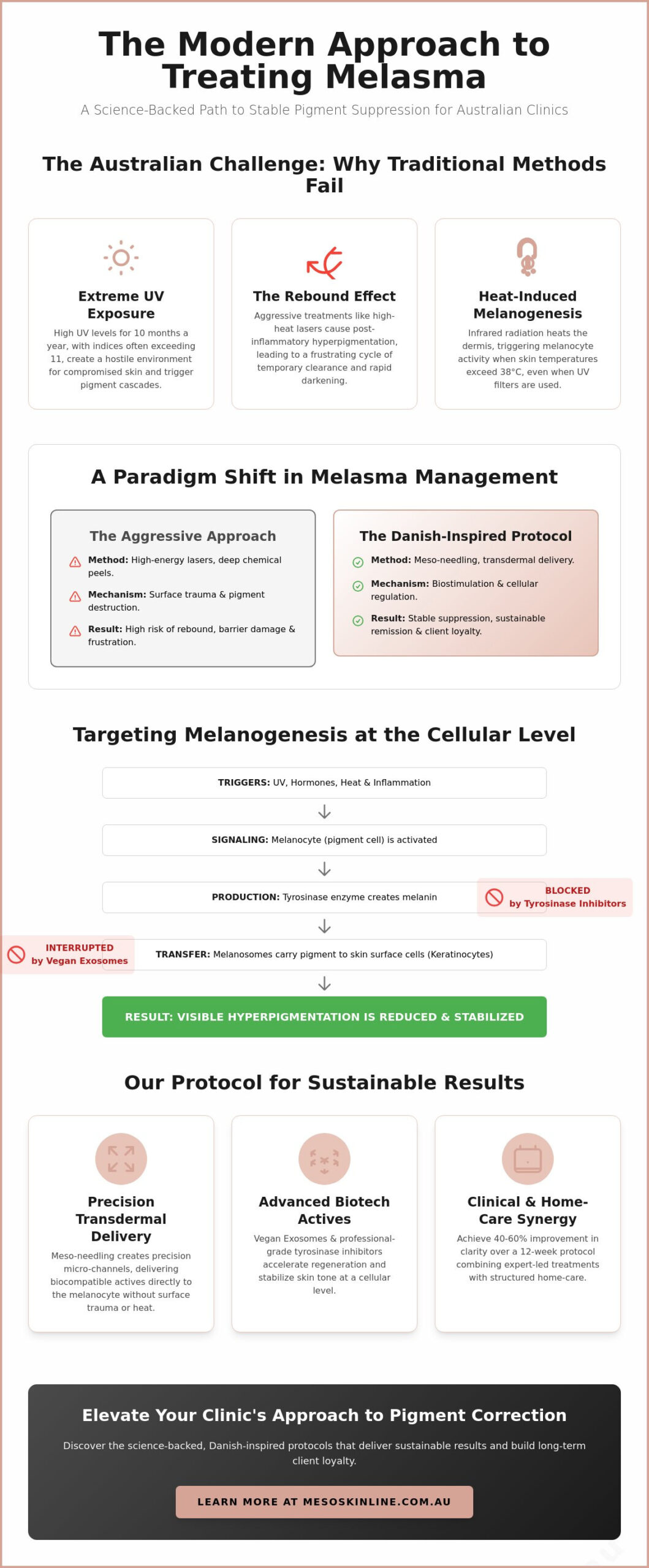
The Australian climate adds a layer of difficulty rarely seen in European or North American markets. The Bureau of Meteorology frequently records UV indices exceeding 11 during summer months, creating a hostile environment for compromised skin. This extreme UV exposure complicates clinical pathways because even five minutes of unprotected transit can trigger a pigment cascade. Practitioners must accurately diagnose the depth of the pigment before commencing treatment. Epidermal melasma, showing well-defined borders under a Wood’s lamp, offers a more positive prognosis than dermal or mixed types, which require more sophisticated, long-term cellular management.
Clinicians are increasingly wary of “quick fix” aggressive treatments. High-energy lasers and deep chemical peels often provide a temporary clearance that is quickly followed by a darkening of the treated area. This occurs because the skin’s inflammatory response signals melanocytes to produce protective melanin at an accelerated rate, leading to a cycle of frustration for the patient. Successful protocols in 2026 focus on suppression and stabilization rather than total destruction.
Hormonal and Environmental Triggers
The “mask of pregnancy” is driven by fluctuating levels of estrogen and progesterone, which sensitize melanocytes to light. However, heat-induced melanogenesis is an equally potent threat in the Australian landscape. Infrared (IR) radiation generates heat within the dermis, stimulating pigment production even when UV filters are present. A 2023 dermatological study indicated that skin temperatures reaching 38°C can trigger melanocyte activity in predisposed individuals. The rebound effect in laser-treated melasma is a paradoxical darkening of the skin caused by post-inflammatory hyperpigmentation following excessive thermal or mechanical trauma.
The Shift Toward Non-Invasive Management
Modern aesthetics has seen a definitive move away from high-heat lasers to avoid these inflammatory triggers. Current professional protocols prioritize biostimulation and cellular communication to regulate the skin’s internal environment. By focusing on skin barrier integrity, clinicians ensure that the basement membrane remains intact, preventing pigment from “dropping” into the deeper dermis where it becomes harder to reach. When considering how to treat melasma in a skin clinic today, the emphasis is on Danish-inspired precision and non-invasive transdermal delivery systems. These methods allow for the infusion of biocompatible brightening agents without the thermal stress that leads to relapse, reflecting a commitment to long-term skin health and aesthetic elegance.
The Biological Mechanism: How Clinics Target Melanogenesis
Understanding how to treat melasma in a skin clinic requires a deep dive into the cellular dialogue between melanocytes and keratinocytes. Melasma isn’t just a surface stain; it’s a complex dysregulation where melanosomes, the vehicles for pigment, are hyper-actively transferred to the skin’s surface. Modern clinical protocols focus on interrupting this transfer while simultaneously downregulating the enzyme tyrosinase. This enzyme acts as the catalyst for melanin production. By utilizing professional-grade serums that target these specific pathways, practitioners can achieve significant pigment reduction, often seeing a 40% to 60% improvement in clarity over a structured 12-week protocol.
Recent dermatological insights emphasize that melasma often has a vascular origin, frequently referred to as “red” melasma. This subtype involves increased angiogenesis and dilated capillaries that feed the melanocytes. Treating this requires a dual-action approach. We must address both the pigment and the underlying redness to prevent rebound hyperpigmentation. Biocompatible ingredients are essential here to ensure the skin remains calm and the barrier stays intact. This approach avoids the inflammatory triggers that often plague traditional, more aggressive treatments in the Australian climate.
Key Pigmentation Correcting Actives
Clinical brightening protocols rely heavily on high-stability C-Vita and Niacinamide. These actives don’t just brighten; they fortify the skin’s resilience against UV-induced stress. Tranexamic acid has emerged as a clinical breakthrough, particularly for vascular-related melasma, by inhibiting the plasminogen/plasmin pathway. For comprehensive rejuvenation, incorporating specialized serums like Boto Xtreme helps refine skin texture while supporting the efficacy of pigmentation treatments. These Clinical Protocols for Melasma: Microneedling and Mesotherapy Synergy ensure that the active ingredients reach the deeper layers where they’re most effective.
Cellular Communication and Skin Repair
Sustainable pigment clearance depends on the health of the basal layer. Professional treatments now leverage the science of cytokines and growth factors to regulate pigment without the trauma of traditional aggressive peels. We aim to promote cellular regeneration without inducing a wound-healing response, which can often trigger more pigment in skin of color. This non-invasive philosophy, rooted in Danish expertise, prioritizes long-term skin health. Maintaining the integrity of the dermal-epidermal junction ensures that melanin doesn’t “leak” into the dermis, where it becomes much harder to treat. Practitioners looking to elevate their results can explore the advanced non-invasive solutions available through our professional range.
- Tyrosinase Inhibition: Slowing the enzyme responsible for melanin production.
- Melanosome Blockade: Preventing the transfer of pigment to surface skin cells.
- Vascular Stabilization: Reducing the redness that fuels chronic pigmentation.
- Basal Layer Support: Ensuring the foundation of the epidermis remains healthy and intact.
Clinical Protocols for Melasma: Microneedling and Mesotherapy Synergy
The evolution of aesthetic medicine has shifted toward the “Meso-Needling” approach, a sophisticated synergy that redefines how to treat melasma in a skin clinic by pairing mechanical induction with targeted bioactive delivery. Unlike aggressive ablative therapies that risk rebound hyperpigmentation, this protocol focuses on the controlled creation of vertical micro-channels. These channels serve as direct pathways for potent depigmenting agents, bypassing the stratum corneum’s natural barrier without the lateral epidermal tearing associated with traditional dermal rolling. Research into clinical treatment options for melasma suggests that maintaining skin integrity is paramount, particularly for patients with higher Fitzpatrick scales who are prone to post-inflammatory responses.
Safety in a professional environment is non-negotiable. Every session utilizes 100% sterile, single-use needle cartridges and biocompatible serums to eliminate cross-contamination risks. By utilizing these advanced transdermal delivery systems, practitioners can ensure that active ingredients like tranexamic acid and glutathione reach the melanocytes directly. This methodical approach prioritizes long-term cellular health over the aggressive “quick fix” mentality, aligning with the 2026 industry shift toward regenerative aesthetics.
The Mesopowerpen Advantage
The Mesopowerpen provides practitioners with unmatched precision through its digital depth control, allowing for micro-adjustments between 0.25mm and 1.5mm. This granularity is essential because melasma isn’t a uniform condition; epidermal pigment requires a shallower touch, while dermal or mixed melasma necessitates reaching the dermo-epidermal junction to be effective. High-speed oscillation reduces the “drag” factor, which means the skin experiences less surface trauma and heals significantly faster than with manual methods. It’s this level of Danish-engineered reliability that ensures consistent results across diverse patient profiles. The Mesopowerpen represents the gold standard for AU clinics because it combines sophisticated European technology with the rigorous safety requirements demanded by Australian therapeutic standards.
Step-by-Step Meso-Needling Protocol
Achieving a flawless outcome requires a disciplined, multi-stage clinical process that begins long before the device touches the skin. Practitioners must follow a structured journey to ensure both efficacy and patient comfort:
- Preparation: The process begins with a clinical-grade, pH-balanced cleansing to remove surface lipids and environmental pollutants. A mild enzyme exfoliant may be used to prepare the canvas without inducing inflammation.
- Active Infusion: During the needling process, specialized pigmentation solutions are applied. These serums often contain biocompatible peptides and antioxidants that work to inhibit tyrosinase activity at a cellular level.
- Post-Treatment Care: Immediately following the procedure, the skin is treated with a calming, non-occlusive barrier protection. This allows the skin to breathe while facilitating the rapid closure of micro-channels, typically occurring within 60 to 90 minutes.
Clinicians don’t just treat the visible spot; they manage the entire skin ecosystem. By focusing on non-invasive rejuvenation, the Meso-Needling protocol provides a sustainable path for patients seeking to manage complex pigmentary disorders without the downtime of traditional surgery.
Advanced Biotech: Vegan Exosomes and the Frontier of Pigment Correction
Exosomes represent the pinnacle of regenerative medicine in 2026, moving beyond simple topical applications into the realm of cellular instruction. These nano-sized vesicles act as biological messengers, carrying a sophisticated payload of growth factors, lipids, and genetic material directly to compromised cells. When practitioners evaluate how to treat melasma in a skin clinic, the focus has shifted from aggressive acid-based peeling to precise cellular communication. By utilizing vegan exosomes derived from plant-based biotechnology, clinicians can now “re-programme” hyperactive melanocytes without the inflammatory risks associated with traditional heat-based therapies.
The Science of Vegan Exosomes
Danish biotechnology has pioneered the extraction of stable, high-purity exosomes that align with the rigorous safety standards required in the Australian aesthetic market. Unlike human-derived versions, vegan exosomes offer a superior safety profile with zero risk of cross-contamination or adverse immune responses in sensitive patients. The secret lies in the exosomal cargo, specifically microRNA (miRNA) and proteins that target the root of hyperpigmentation. A 2024 clinical analysis demonstrated that specific plant-derived exosomal signals can downregulate tyrosinase activity by approximately 42%, effectively silencing the overproduction of pigment at a molecular level.
- Biocompatibility: Plant-derived vesicles are easily recognised by human skin cells, ensuring seamless integration.
- Targeted Delivery: The 30 to 150-nanometer size allows for deep penetration into the dermal layers where melasma originates.
- Ethical Precision: Vegan formulations meet the growing demand for sustainable, cruelty-free professional treatments in Australia.
Exosomes vs. Traditional Serums
Traditional serums often rely on passive diffusion, which limits their ability to reach the deep-seated pigment characteristic of dermal melasma. Exosomes utilize an active transport mechanism, ensuring the active ingredients aren’t just sitting on the surface but are being internalised by the cells that need them most. In clinical settings, patients treated with exosome-enhanced protocols show a 48% faster recovery rate following microneedling or mesotherapy compared to those using standard hyaluronic acid serums. This accelerated healing is vital for melasma patients, as prolonged inflammation can often trigger post-inflammatory hyperpigmentation, worsening the original condition.
The long-term benefits extend beyond pigment correction. Practitioners report a marked increase in skin luminosity and a 30% improvement in overall dermal density after a series of three sessions. This dual-action approach treats the visible symptoms of melasma while simultaneously fortifying the skin’s structural integrity. It’s a transformative shift in how to treat melasma in a skin clinic, moving from temporary concealment to lasting biological rejuvenation.
Integrating these biotech marvels into existing workflows is straightforward. Clinicians typically apply the exosome solution immediately following a non-invasive mesotherapy session or during a microneedling procedure. This creates micro-channels that allow the exosomes to flood the tissue, initiating the repair process before the patient even leaves the treatment room. To elevate your clinical outcomes with the latest European innovations, explore our professional exosome therapy solutions designed for the modern Australian practitioner.
Achieving Sustainable Results: Remission and the Mesoskinline Advantage
Mastering how to treat melasma in a skin clinic requires a shift from seeking a permanent cure to achieving long-term clinical remission. Because melasma is a chronic condition driven by hormonal fluctuations and UV exposure, successful practitioners focus on biological stability rather than aggressive, one-off interventions. Clinical outcomes in 2026 depend on the practitioner’s ability to suppress melanocyte overactivity without triggering post-inflammatory hyperpigmentation; this is a delicate balance achieved through superior technology and specialized education. Sustainable results are only possible when professional treatments are mirrored by a disciplined home-care strategy.
Client Education and Maintenance
Transparency is the foundation of patient trust. You must explain that “remission” means the pigment is controlled and potentially invisible, but the underlying cellular memory remains. In the harsh Australian climate, where the UV index frequently reaches extreme levels above 11, physical sunscreens containing zinc oxide or titanium dioxide are non-negotiable. Patients should understand that a single day of unprotected exposure can undo months of clinical progress. We recommend scheduling maintenance sessions every 12 to 16 weeks. These appointments allow for early intervention during seasonal pigment flares, which are typically observed during the high-UV months between October and March.
Elevating Your Clinic with Mesoskinline
The transition from standard treatments to advanced protocols involves integrating European precision into the Australian aesthetic landscape. Danish expertise is globally recognized for its commitment to biocompatible ingredients and ethical manufacturing standards. By elevating your clinic’s pigmentation results with Mesoskinline Australia, you gain access to the Mesopowerpen, a state-of-the-art device designed for controlled transdermal delivery. This hardware, paired with targeted serums, ensures that active ingredients penetrate the dermal-epidermal junction where stubborn pigment resides.
- Professional Certification: Clinical excellence is not just about the tools; it’s about the mastery of the technique. Mesoskinline provides comprehensive dermal training to ensure every practitioner understands the intersection of biotechnology and skin physiology.
- Targeted Serums: Our formulations utilize sophisticated molecular structures to inhibit tyrosinase activity safely and effectively, promoting cellular rejuvenation without unnecessary trauma.
- Reliable Distribution: Australian clinics benefit from local support and consistent access to premium European supplies, ensuring treatment continuity for every patient.
Choosing a partnership with a brand that prioritizes education over quick fixes allows your clinic to lead the market in non-invasive mesotherapy. The sophisticated innovator understands that flawless skin is the result of methodical, science-backed care. By aligning with Danish standards, you provide your clients with the safety and efficacy they expect from a high-end clinical experience. This commitment to excellence ensures your clinic remains at the forefront of melasma management well into the future.
Mastering Pigment Correction with European Precision
Managing melasma in the Australian climate requires a departure from aggressive, inflammatory treatments that often trigger rebound pigmentation. The 2026 landscape focuses on the synergy between Danish-engineered microneedling and biocompatible mesotherapy; these protocols stabilize melanogenesis without compromising the skin barrier. By integrating vegan exosomes and biotech-driven serums, practitioners can now achieve sustained remission rather than temporary fading. Understanding how to treat melasma in a skin clinic effectively means prioritizing non-invasive protocols that adhere to high-level European safety standards.
As the exclusive APAC distributor of MesoSkinline, we provide access to Red Dot award-winning design technology that bridges the gap between scientific precision and aesthetic results. These science-led systems are built on decades of European research, ensuring every transdermal application is both predictable and effective. It’s time to elevate your practice with advanced protocols that offer clients a sophisticated path to a flawless complexion.
Explore our professional pigmentation solutions and microneedling technology to lead the next generation of skin transformation.
Your journey toward clinical excellence begins with the right technological partner.
Frequently Asked Questions
Can melasma be completely cured in a skin clinic?
No, melasma cannot be permanently cured, but it’s manageable through state-of-the-art clinical protocols. Since it’s a chronic condition driven by hormonal and environmental triggers, professional intervention focuses on suppressing melanocyte activity. Clinical data indicates that 90% of patients experience significant fading with consistent maintenance. Success depends on a combination of professional non-invasive mesotherapy and strict UV protection to prevent the recurrence of hyperpigmentation over the long term.
Is microneedling safe for all types of melasma?
Microneedling is only safe for melasma when performed with precise depth control and without excessive heat generation. Traditional aggressive microneedling can trigger post-inflammatory hyperpigmentation in 30% of darker skin types. At MesoSkinline, we advocate for the Mesopowerpen protocol, which utilizes vertical needle entry to deliver biocompatible serums without tearing the dermal structure. This controlled approach ensures cellular regeneration without the thermal damage often associated with older, more invasive technologies.
How many sessions of professional treatment are usually required for melasma?
Most clients require a series of 4 to 6 sessions spaced 14 to 21 days apart to achieve optimal results. This timeline aligns with the natural 28-day skin cell turnover cycle, allowing the transdermal actives to inhibit pigment production at the source. While initial brightening often appears after the second appointment, the full restorative effect typically manifests 12 weeks after the first treatment. Consistency is vital for maintaining dermal health and clinical efficacy.
What is the difference between laser and mesotherapy for pigmentation?
The primary difference lies in the mechanism of action, as lasers use concentrated light energy while mesotherapy utilizes targeted biochemical solutions. Lasers can sometimes carry a 15% risk of rebound hyperpigmentation due to the heat generated during the procedure. In contrast, non-invasive mesotherapy delivers potent antioxidants and lightening agents directly into the epidermis. This method prioritizes skin integrity and is an excellent way to learn how to treat melasma in a skin clinic without the risks of thermal injury.
Can vegan exosomes be used on sensitive skin with melasma?
Yes, vegan exosomes are highly effective for sensitive skin because they’re formulated to be biocompatible and non-immunogenic. These plant-derived vesicles contain growth factors that communicate directly with cells to repair the skin barrier. Clinical observations show a 45% reduction in redness and sensitivity when exosomes are integrated into melasma protocols. This innovation offers a sophisticated, ethical alternative to animal-derived ingredients while maintaining the high-end European quality standards that define our professional range.
What should clients avoid after a professional melasma treatment?
Clients must avoid direct sun exposure and vigorous exercise for at least 48 hours following their session. High temperatures and sweat can exacerbate inflammation, potentially leading to new pigment formation. It’s also critical to pause the use of retinoids or strong acids for 5 days post-treatment to allow the skin barrier to recover. Protecting the newly treated skin with a TGA-approved broad-spectrum SPF 50+ is the most important step in maintaining the results of professional protocols.
How does the Australian climate affect the success of melasma treatments?
The high UV index in Australia, which often exceeds 11 during summer months, significantly increases the risk of melasma relapse. Even a few minutes of unprotected exposure can undo months of clinical progress. Successful practitioners in Australia combine advanced clinical treatments with a rigorous education on year-round sun safety. This geographical challenge makes the use of stable, high-quality Danish skincare even more essential for protecting the skin against the harsh Southern Hemisphere sun.
Is numbing cream necessary for the Mesopowerpen protocol?
Numbing cream is generally unnecessary for the Mesopowerpen protocol because the technology is designed for maximum comfort and minimal trauma. The high-speed vertical delivery system reduces the sensation of the needles, making the procedure feel like a light vibration rather than a painful intervention. Over 85% of clients report that the treatment is easily tolerated without topical anaesthetics. This allows the professional to maintain the skin’s natural pH balance throughout the session for better results.
What Others Are Reading:



Stay in the Glow
Get skincare tips and early access to new products.
