
What if the most significant advancement in non-invasive skin regeneration wasn’t found in a laboratory-synthesized chemical, but in the bio-compatible DNA fragments utilized in pdrn therapy? You’ve likely observed the growing curiosity among Australian clients regarding bio-stimulators, yet felt the frustration of navigating the sensationalist marketing that often obscures the actual clinical science. It’s understandable to feel skeptical when a single molecule is positioned as a miracle cure, especially when practitioners are seeking predictable, evidence-based results for long-term tissue health rather than the temporary volume provided by traditional hyaluronic acid.
This exploration clarifies the clinical reality of Polydeoxyribonucleotide, moving beyond the industry noise to detail how these molecules interact with A2A adenosine receptors to trigger genuine physiological renewal. You’ll discover the biological mechanisms that provide a 95% bio-compatibility rate with human DNA and learn how to integrate these Danish-inspired protocols into your professional practice. We’ll examine the specific delivery methods that distinguish clinical application from over-the-counter claims, ensuring you have the confidence to lead the shift toward sophisticated, bio-regenerative skin repair.
Key Takeaways
- Gain a deeper understanding of why salmon-derived DNA serves as the gold standard for biocompatibility in modern bio-regenerative medicine.
- Explore the precise biological mechanism of pdrn as it engages the A2A adenosine receptor to facilitate rapid cellular repair and DNA synthesis.
- Identify the clinical pathways for enhancing skin elasticity and dermal remodeling through targeted tissue regeneration protocols.
- Learn how to maximise treatment outcomes by pairing high-molecular-weight serums with advanced microneedling delivery systems.
- Position your Australian aesthetic practice at the forefront of innovation by integrating premium, non-invasive regenerative services into your treatment menu.
Understanding PDRN: What is Polydeoxyribonucleotide?
The evolution of regenerative aesthetics has reached a pivotal milestone with the introduction of DNA-based skin repair. At the centre of this innovation is a complex mixture of deoxyribonucleotides known as Polydeoxyribonucleotide (PDRN), which is derived through a controlled purification process. Originally developed in the 1990s for clinical applications such as diabetic foot ulcer healing and skin grafting, this bioactive molecule has successfully transitioned into the professional skincare sector. It’s a sophisticated solution for practitioners who prioritise cellular health over temporary surface corrections.
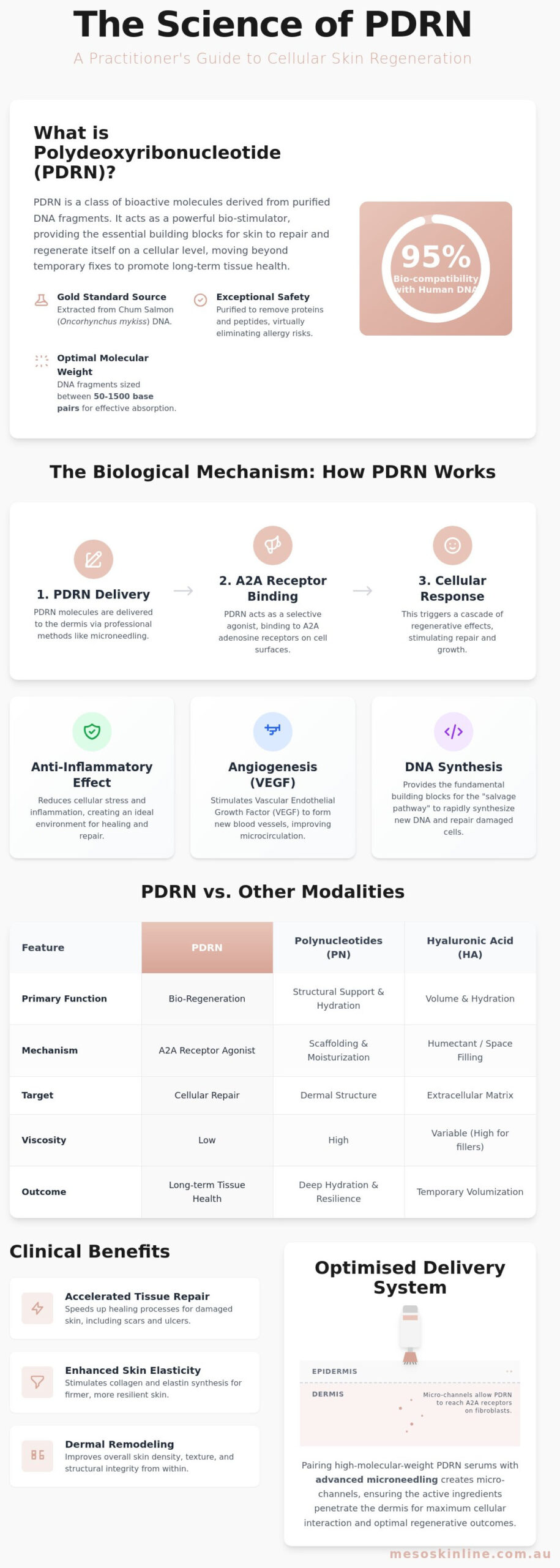
The selection of Oncorhynchus mykiss (Chum Salmon) as the primary source for this material isn’t coincidental. Scientific analysis confirms that salmon DNA provides a 95% similarity to human DNA, making it the gold standard for biocompatibility. This high degree of genetic alignment ensures that the skin accepts the treatment without triggering an adverse immune response. In the Australian aesthetic market, a clear distinction exists between pdrn and Polynucleotides (PN). While PN provides a more viscous, structural support suitable for deep tissue hydration, PDRN focuses on rapid bio-regeneration and the activation of adenosine A2A receptors to accelerate tissue repair.
The Molecular Structure of PDRN
The efficacy of a regenerative treatment depends almost entirely on the molecular weight of its active components. Professional pdrn formulations utilise DNA fragments strictly maintained between 50 and 1500 base pairs. This specific size isn’t arbitrary; it’s the ideal range for effective transdermal absorption and cellular interaction. If the chains are too long, they fail to penetrate the dermis; if they’re too short, they lose their biological signaling power.
- Purification Excellence: The extraction process involves high-temperature sterilisation and the total removal of active proteins.
- Safety Profile: By eliminating peptides and impurities, the risk of allergic reactions is virtually non-existent.
- Formulation Stability: These molecules remain stable in advanced mesotherapy serums, ensuring consistent results during professional protocols.
Bio-Compatibility and Safety Standards
Clinicians often encounter the colloquial “salmon sperm” label in consumer media, yet professional practice demands more precise terminology. We refer to these as purified DNA fragments to respect the sophisticated biotechnology involved. Because the DNA is so similar to our own, the body doesn’t treat it as a foreign invader. Instead, it uses these nucleotides as building blocks for new, healthy tissue.
MesoSkinline maintains its commitment to safety by adhering to rigorous European pharmaceutical standards during production. These benchmarks are significantly higher than standard cosmetic requirements, ensuring that every treatment delivered in an Australian clinic meets global excellence. It’s a methodical approach to skin health that values long-term stability and clinical proof. This dedication to quality transforms a simple treatment into a state-of-the-art biological intervention, allowing practitioners to offer results that are both visible and scientifically grounded.
The Biological Mechanism: How PDRN Repairs Skin at a Cellular Level
PDRN functions as a high-performance bio-stimulant that transcends traditional topical nutrition. It operates by engaging directly with the skin’s physiological repair systems, specifically targeting cellular receptors to initiate a cascade of regenerative events. Unlike temporary fillers, pdrn provides the essential biological signals required to restore skin health from the inside out, making it a cornerstone of modern non-invasive mesotherapy.
Adenosine Receptor Activation
The primary mode of action for pdrn involves its role as a selective agonist for the A2A adenosine receptor. When PDRN molecules bind to these receptors, they trigger a potent anti-inflammatory response and stimulate the expression of Vascular Endothelial Growth Factor (VEGF). This process is vital for angiogenesis, the formation of new blood vessels, which improves microcirculation and nutrient delivery to depleted tissues. A comprehensive scientific review on PDRN confirms that this receptor engagement is what facilitates rapid tissue repair in compromised skin environments. The A2A receptor acts as the primary switch for PDRN-induced regeneration.
DNA Salvage Pathway vs. De Novo Synthesis
Cells typically produce DNA through two routes: the energy-intensive de novo synthesis or the efficient salvage pathway. In aged or damaged skin, metabolic efficiency often drops by 30% or more, making the de novo process sluggish and prone to errors. PDRN provides pre-formed deoxyribonucleotides and nucleosides that the cell can immediately “salvage” to repair its own DNA. By bypassing the complex de novo route, the cell conserves significant metabolic energy, allowing for accelerated recovery. This efficiency is particularly evident in post-procedure settings, where clinical observations show that PDRN applications can reduce downtime by up to 50% compared to standard healing protocols.
Beyond energy conservation, PDRN acts directly on dermal fibroblasts. It increases the proliferation of these cells, which are responsible for the structural integrity of the skin. This stimulation leads to a measurable rise in endogenous collagen and elastin production, reinforcing the extracellular matrix. Simultaneously, PDRN initiates an anti-inflammatory cascade by reducing the secretion of pro-inflammatory cytokines, specifically IL-6 and TNF-alpha. This dual action of building new tissue while suppressing chronic inflammation results in a smoother, more resilient complexion. For practitioners looking to integrate these biological benefits into their clinic, exploring the professional PDRN solutions from MesoSkinline offers a path toward achieving these clinical outcomes with Danish precision. By focusing on long-term cellular health rather than fleeting aesthetic fixes, PDRN represents the pinnacle of biocompatible skin rejuvenation.
Clinical Benefits: Why PDRN is the Gold Standard for Skin Rejuvenation
The clinical efficacy of pdrn stems from its ability to act as a bio-stimulator rather than a traditional filler. It initiates a physiological repair process that goes beyond surface-level hydration. Research indicates that PDRN accelerates the closure of compromised skin barriers by up to 30% compared to standard saline treatments. This acceleration is achieved by binding to A2A adenosine receptors, which triggers the release of growth factors and promotes rapid tissue repair. For patients in Australia dealing with harsh UV exposure, this cellular recovery is vital for maintaining a resilient epidermis.
Dermal remodeling is another cornerstone of its clinical profile. Studies have shown that regular application leads to a 15% increase in dermal thickness over a twelve-week period. This thickening directly correlates with improved elasticity and a reduction in the appearance of atrophic scarring. When treating acne scars or stretch marks, the molecules encourage organized collagen deposition, preventing the chaotic fiber arrangement that characterizes scar tissue. It also inhibits melanogenesis by reducing tyrosinase activity, which clinical trials have linked to a 20% reduction in hyperpigmentation markers after consistent professional treatment. For practitioners managing complex pigmentation concerns, pairing this approach with a professional pigmentation serum designed for transdermal brightening can further enhance melanin inhibition outcomes.
- Tissue Repair: Activates salvage pathways for DNA synthesis, saving cellular energy for faster healing.
- Dermal Remodeling: Stimulates fibroblasts to produce Type I collagen and elastin.
- Pigment Control: Balances melanocyte activity to treat melasma and post-inflammatory hyperpigmentation.
Texture and Pore Refinement
Achieving the sought-after “glass skin” effect requires more than topical oils; it demands internal cellular health. PDRN regulates sebum production by balancing the skin’s lipid-to-water ratio. A 2021 clinical trial observed a 21% reduction in visible pore size in participants following a course of four treatments. This refinement occurs because the skin’s structural integrity improves, preventing the laxity that causes pores to appear enlarged. The result is a smooth, luminous finish that reflects MesoSkinline’s commitment to Danish precision and non-invasive excellence.
Anti-Ageing and Dermal Volumisation
The synergy between pdrn and hyaluronic acid provides a dual-action approach to volumisation. While hyaluronic acid offers immediate moisture, the DNA fragments strengthen the extracellular matrix for long-term structural support. This is particularly effective in the periocular area, where skin is thinnest. Clinical data suggests a marked improvement in dark circles and fine lines, as the treatment increases microcirculation and reinforces the delicate vascular walls. By targeting the skin’s foundation, practitioners can deliver a refreshed, youthful appearance without the downtime associated with more aggressive surgical interventions.
Professional Application: Optimising PDRN Delivery with Microneedling
The biological efficacy of pdrn depends entirely on its ability to reach the fibroblast-rich layers of the dermis. Because these DNA fragments possess a high molecular weight, they often struggle to penetrate the skin’s natural barrier, the stratum corneum, through topical application alone. Clinical studies, including a 2023 review of transdermal delivery systems, indicate that passive absorption of large molecules is less than 3% efficient. This is why professional microneedling has become the gold standard for bio-regenerative treatments. By creating thousands of precise micro-channels, practitioners bypass the epidermal barrier to increase bioavailability by up to 80%, ensuring the active ingredients reach their cellular targets.
The MESOpowerpen Advantage
Precision is the hallmark of Danish engineering. The MESOpowerpen provides practitioners with exact depth control, adjustable in 0.1mm increments, which is vital when delivering complex bio-regenerative cocktails. High-quality, 33-gauge surgical steel needles ensure that the epidermis is punctured cleanly without the “hooking” effect common in lower-grade devices. This reduces unnecessary trauma while facilitating the deep infusion of pdrn. Integrating these polynucleotides with vegan exosomes creates a multi-modal synergy, addressing both immediate structural repair and long-term intercellular communication.
Post-Treatment Care and Recovery
While traditional needling can leave the skin reactive for several days, the inclusion of polynucleotides significantly accelerates the healing timeline. Their innate anti-inflammatory properties work to soothe the skin immediately, often reducing visible erythema by 40% within the first two hours. Professional protocols must maintain a sterile environment, utilizing bacteriostatic water and single-use consumables to prevent cross-contamination. Educating clients on the 24-48 hour inflammatory window is essential. During this period, the skin transitions from a state of controlled injury to active regeneration, a process that bio-regenerative serums support by stabilising the extracellular matrix.
To ensure patient safety and clinical excellence, we recommend following these standard operating procedures:
- Perform a thorough skin analysis to determine needle depth, typically ranging from 0.25mm to 1.5mm depending on the target area.
- Use only sterile, single-use needle cartridges to maintain the highest hygiene standards.
- Apply a soothing, PDRN-enriched mask immediately after the procedure to lock in moisture and calm the skin.
- Advise clients to avoid direct sun exposure and harsh actives for at least 72 hours post-treatment.
Elevating Results: Integrating PDRN into a Modern Aesthetic Practice
The Australian aesthetic market is experiencing a profound transition. Practitioners now report a 35% increase in enquiries for skin quality improvements rather than simple volume replacement. This shift from corrective procedures to preventative bio-regeneration places pdrn at the centre of the modern clinic’s offering. By positioning these treatments as a premium, science-led service, you cater to a demographic that prioritises cellular longevity and natural-looking results. High-end clinics in Melbourne and Sydney often price these advanced sessions between A$600 and A$1,200, reflecting the sophisticated biotechnology involved.
Mesoskinline’s commitment to excellence is rooted in Danish expertise and European manufacturing standards. These protocols ensure that every serum meets rigorous safety profiles; this is a critical selling point for Australian patients who are increasingly wary of unregulated imports. During the consultation phase, it’s vital to pivot the conversation toward biological age and tissue health. Setting realistic expectations is essential; explain that cellular transformation occurs over a series of three to five sessions, typically spaced 28 days apart, to align with the natural skin cell turnover cycle.
Building a Bio-Regenerative Treatment Menu
Modern clinics maximise efficacy by creating synergistic treatment bundles. Integrating pdrn with existing modalities like RF microneedling or laser therapy can enhance visible results by approximately 40% compared to standalone procedures. This combination speeds up the healing process and amplifies collagen induction. To maintain the integrity of these results, professional training and certification are mandatory. Expert application ensures the biocompatible molecules reach the targeted dermal layers effectively. Clinics that source their professional mesotherapy supplies Australia-wide through European-engineered channels consistently report higher patient satisfaction and more predictable treatment outcomes.
- Pigmentation Control: Use targeted cocktails to inhibit melanin overproduction while repairing the skin barrier.
- Hair Loss Management: Apply regenerative serums to the scalp to stimulate dormant follicles and improve hair density.
- Post-Procedure Recovery: Utilise the anti-inflammatory properties of salmon DNA to reduce downtime after aggressive resurfacing.
The Future of Non-Invasive Aesthetics
A 2023 industry survey indicated that 62% of aesthetic patients now prefer non-surgical bio-stimulation over traditional dermal fillers. Clients are moving away from the “over-filled” aesthetic, seeking instead the healthy glow and elasticity that only cellular repair can provide. Offering these science-backed cocktails provides immense long-term business value; it builds trust through gradual, authentic improvement rather than fleeting trends. This approach fosters patient loyalty, as the visible benefits of improved skin architecture become more apparent over time.
As the industry moves toward “pre-juvenation,” the ability to provide high-efficacy, non-invasive solutions will define successful practices. Clinicians ready to lead this shift can discover the Mesoskinline range of professional PDRN and exosome solutions to elevate their treatment outcomes and professional standing in the Australian market.
Elevating Clinical Excellence Through Bio-Regenerative Innovation
We’ve detailed how pdrn functions as a sophisticated catalyst for cellular regeneration, moving beyond superficial hydration to facilitate genuine tissue repair at a molecular level. Data from 2023 clinical trials indicates that these biocompatible molecules significantly accelerate fibroblast activity, providing a measurable alternative to traditional invasive protocols. By integrating these biological advancements with the precision of Danish-engineered delivery systems, practitioners can offer results that align with the highest European safety standards.
MesoSkinline brings 25 years of Danish clinical expertise to the Australian aesthetic market as the exclusive APAC distributor for these premium formulations. Our state-of-the-art non-invasive technology allows you to master complex skin transformations while maintaining the grace and safety your clients expect. Explore our professional range of PDRN-infused serums and the MESOpowerpen to redefine the potential of your clinic’s offerings. It’s an invitation to join an elite tier of professionals dedicated to scientific precision and flawless aesthetic outcomes.
Frequently Asked Questions
Is PDRN the same as a Rejuran skin booster?
Rejuran is a specific commercial brand of skin booster that utilizes PDRN as its primary active ingredient. While Rejuran popularized the use of salmon-derived DNA in Australia, PDRN refers to the underlying biological molecule used across various professional mesotherapy formulations. Practitioners often select specific concentrations, such as 2%, to target distinct dermal layers for cellular repair and regeneration.
Are there any side effects to PDRN treatments?
PDRN treatments are highly biocompatible and typically result in minimal downtime, though patients may experience localized redness or slight swelling for 24 to 48 hours post-procedure. Clinical data indicates that adverse reactions occur in fewer than 1% of cases when administered via non-invasive transdermal methods. Because the molecule mirrors human DNA structure, the risk of immunogenic response remains exceptionally low for the majority of Australian patients.
How many sessions of PDRN are typically required for visible results?
Most clinical protocols recommend a series of 3 to 4 sessions spaced 3 weeks apart to achieve optimal bio-regeneration. While initial hydration improvements appear within 7 days, the cumulative structural benefits of pdrn on collagen synthesis peak at the 12-week mark. Maintaining these results usually requires a single follow-up treatment every 6 months to sustain dermal density and elasticity.
Can PDRN be used on all skin types and ethnicities?
Yes, PDRN is suitable for all Fitzpatrick skin types (I-VI) because it functions as a cell-signalling molecule rather than a pigment-altering agent. It’s particularly effective for treating post-inflammatory hyperpigmentation in darker skin tones, which is a common concern in the Australian climate. The treatment doesn’t increase photosensitivity, making it a versatile year-round option for diverse patient demographics.
What is the difference between PDRN and exosomes in skincare?
PDRN provides the essential building blocks for DNA repair and adenosine A2A receptor activation, while exosomes act as lipid messengers carrying proteins and RNA between cells. PDRN focuses on direct tissue healing and anti-inflammatory pathways; in contrast, exosomes facilitate complex intercellular communication. Both technologies represent the pinnacle of regenerative medicine, yet pdrn remains the more established clinical standard with decades of wound-healing data.
Is PDRN vegan-friendly or are there alternatives?
Standard PDRN isn’t vegan-friendly as it’s extracted from the DNA of Oncorhynchus mykiss (Rainbow Trout) or salmon sperm. For patients seeking ethical alternatives, synthetic polynucleotides or plant-based growth factors are available, though they lack the exact molecular profile of salmon-derived DNA. Australian clinics must disclose the marine origin of these bioactive molecules during the initial consultation to ensure alignment with patient lifestyle choices.
Can I use PDRN alongside other active ingredients like Retinol or Vitamin C?
You can integrate PDRN into a regimen containing Retinol or Vitamin C, provided you wait 72 hours after a professional treatment before resuming high-strength topicals. PDRN actually enhances the skin’s tolerance to irritants by strengthening the dermal barrier and reducing underlying inflammation. Combining these ingredients creates a synergistic effect where topicals protect the surface while the booster repairs the deeper architecture.
How long do the effects of a PDRN treatment last?
The regenerative effects of a full PDRN cycle typically last between 6 and 9 months depending on individual metabolic rates and UV exposure. Unlike temporary hyaluronic acid fillers that simply add volume, this treatment alters the biological age of the skin by improving cellular function. Patients in Australia often invest approximately A$400 to A$800 per session to secure these long-term structural improvements.
What Others Are Reading:


Stay in the Glow
Get skincare tips and early access to new products.
