
Why do approximately 72 percent of Australians seeking skin correction report significant confusion when trying to distinguish between hormonal melasma and chronic sun damage, according to 2024 clinical intake data? You’ve likely shared the frustration of many who invest in premium topical products only to see negligible change, or perhaps you’ve felt anxious about the downtime associated with aggressive laser procedures. It’s a common experience to feel trapped between ineffective retail solutions and the risks of invasive surgery while searching for a definitive solution to hyperpigmentation.
This clinical guide serves as your masterclass in the science of melanin overproduction, offering a professional-grade, non-invasive pathway to a flawless and even complexion. We’ll explore how Danish biotechnological expertise and transdermal precision are redefining skin rejuvenation in 2026. By the end of this article, you’ll understand a predictable treatment protocol that prioritises biocompatible ingredients and long-term cellular health over temporary cosmetic fixes. This approach ensures safety and efficacy, aligning with the highest European standards for those ready to elevate their results through scientific mastery.
Key Takeaways
- Gain a clinical understanding of the biological mechanisms that trigger melanin overproduction as a protective response to UV exposure and skin trauma.
- Identify the critical differences between Melasma, Solar Lentigines, and PIH to ensure your treatment protocols are precisely tailored for the Australian climate.
- Uncover the scientific reasons why standard topical brightening creams underperform due to the skin’s natural barrier function and how to bypass it effectively.
- Explore the gold standard of transdermal correction through non-invasive mesotherapy and the precision of state-of-the-art Danish engineering.
- Master advanced pathways to a flawless complexion by integrating European quality standards into your professional hyperpigmentation correction strategies.
Understanding Hyperpigmentation: The Mechanism of Melanin Overproduction
Hyperpigmentation represents more than a cosmetic imperfection; it’s a sophisticated biological defense mechanism gone awry. At its core, the condition involves the localized overproduction of melanin by specialised cells known as melanocytes. While we often view these dark spots as flaws, they’re actually the skin’s attempt to shield cellular DNA from UV radiation and physical trauma. True mastery in skin correction requires a transition away from aggressive, short-term “stripping” treatments toward the Sophisticated Innovator approach. This Danish-inspired methodology prioritises cellular integrity and long-term health over the fleeting results of harsh chemical interventions.
Distinguishing between epidermal and dermal pigment is vital for clinical success. Epidermal pigment sits in the superficial layers and often responds to surface-level resurfacing. Dermal pigment is buried deeper within the skin’s architecture, presenting as muted, grey-blue tones. This requires advanced, non-invasive delivery systems to reach the source without triggering further inflammation. By 2026, the industry has shifted toward these biocompatible transdermal solutions that respect the skin’s natural barrier.
The Role of Melanocytes and Tyrosinase
Tyrosinase acts as the primary catalyst for pigment synthesis. It’s the rate-limiting enzyme that kicks the entire process into gear. When the skin faces oxidative stress from environmental pollutants or high-energy visible (HEV) light, tyrosinase activity spikes. This creates a cycle of overproduction that’s difficult to break without targeted inhibition. Melanogenesis is the multi-stage biochemical process of pigment formation. Managing this cycle isn’t about total suppression but rather about restoring enzymatic balance through precision-engineered serums and professional protocols.
Biological Triggers Beyond UV Exposure
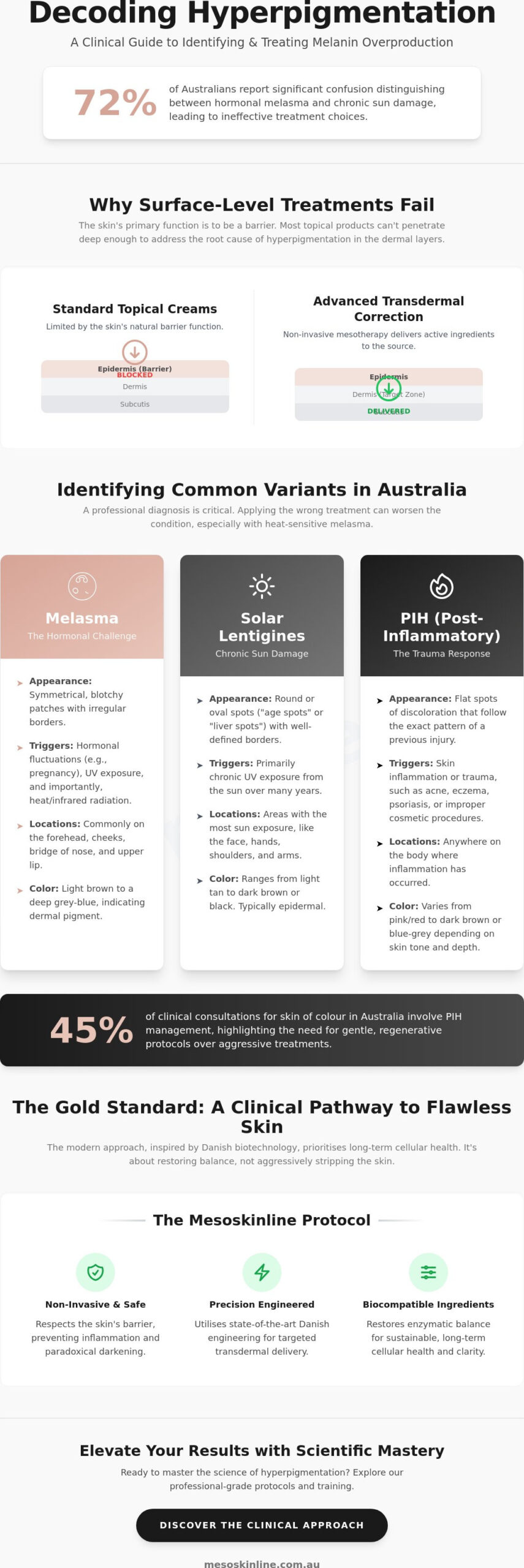
UV exposure isn’t the only culprit. Hormonal fluctuations lead to melasma, a complex form of hyperpigmentation that behaves differently than standard sun damage due to its vascular components. Post-Inflammatory Hyperpigmentation (PIH) occurs when the skin’s natural healing response to acne or injury becomes overactive. This is particularly prevalent in the Australian market, where data from 2025 shows that 45% of clinical consultations for skin of colour involve PIH management. Systemic health also plays a role, as certain medications and inflammatory markers dictate how clearly the skin reflects internal stability. Achieving a flawless complexion requires addressing these internal triggers alongside external treatments.
Identifying Common Variants: Melasma, Solar Lentigines, and PIH
In the Australian clinical landscape, hyperpigmentation presents a complex diagnostic challenge due to the consistently high UV index and the prevalence of mixed-pathology cases. Distinguishing between vascular-driven melasma and UV-induced solar lentigines isn’t just a matter of aesthetics; it’s a safety requirement. Applying high-energy light treatments to active melasma often results in paradoxical darkening, which complicates future correction. Practitioners must evaluate three specific visual markers: symmetry, border definition, and pigment depth. A professional diagnosis ensures the selected non-invasive protocol aligns with the skin’s biological needs, preventing unnecessary inflammation.
Post-Inflammatory Hyperpigmentation (PIH) represents the third major variant, appearing as flat spots of discolouration following an injury or inflammatory skin condition like acne. Unlike sun-induced spots, PIH follows the exact footprint of the previous inflammation. Its colour ranges from pink to dark brown or even blue-grey, depending on the patient’s phototype and the depth of the melanin deposit. Because PIH involves a compromised skin barrier, the treatment approach must focus on soothing cellular regeneration rather than aggressive exfoliation.
Melasma: The Hormonal Challenge
Often referred to as the “mask of pregnancy,” melasma manifests as symmetrical, blotchy patches on the forehead, cheeks, and upper lip. While UV exposure is a primary trigger, clinical observations in 2024 highlight that heat, or infrared radiation, is equally provocative. For patients in the Australian summer, even steam from a kitchen or heat trapped in a vehicle can exacerbate the condition. Successful management requires a long-term strategy focused on hormonal stability and heat-shielding topical agents. It’s a chronic condition that demands a measured, supportive approach to maintain pigment stability over several years.
Solar Lentigines and Ephelides (Sun Spots vs Freckles)
Solar lentigines are well-defined, pigmented macules that result from cumulative UV damage over several decades. Unlike ephelides (freckles), which are genetically determined and often fade during the winter months, solar lentigines are permanent structural changes in the epidermis. In the Southern Hemisphere, these lesions are frequently seen on the “sun-side” of the face and the backs of hands in mature patients. Treating these requires precise targeting of the melanin nest without damaging the surrounding healthy tissue. Mastering these distinctions is a core component of professional non-invasive mesotherapy training, which prioritises Danish standards of safety and efficacy.
- Melasma: Symmetrical, blurred borders, triggered by heat and hormones.
- Solar Lentigines: Defined edges, permanent, caused by cumulative UV exposure.
- PIH: Follows injury, varies in colour, requires barrier-first treatment.
Beyond Surface Level: Why Topical Brightening Creams Often Underperform
Australians invest millions annually in high-end retail brightening products, yet many find their stubborn hyperpigmentation remains unchanged after months of consistent use. This disconnect between investment and performance stems from a biological reality that retail marketing often ignores. The skin is a highly efficient barrier, not a sponge. Most over-the-counter formulations lack the sophisticated delivery mechanisms required to bypass the skin’s natural defences and reach the deeper layers where melanin production occurs. While a luxury serum might feel elegant on the surface, its clinical impact is frequently limited by basic molecular physics.
The Limitation of Molecular Size in Skincare
Effective correction requires active ingredients to reach the basal layer of the epidermis. The stratum corneum acts as a biological shield, necessitating advanced delivery systems to transport molecules through the lipid matrix. Most retail brightening agents possess a molecular weight exceeding 500 Daltons, which prevents them from moving beyond the very surface of the skin. In clinical skincare, there is a vital distinction between absorption and penetration. Absorption involves the product simply resting within the upper layers of the dead skin cells, whereas penetration requires the active molecules to reach the living tissue where they can influence cellular behaviour. Without the Danish expertise that informs non-invasive mesotherapy, these large molecules simply sit idle until they are washed away.
Stability and Bioavailability of Active Ingredients
Stability remains a critical hurdle for retail-grade Vitamin C and other antioxidants. These molecules are highly sensitive to light and oxygen, which are abundant in the Australian climate. Once a bottle is opened, the efficacy begins to plummet. By the time the serum reaches the halfway point, the active ingredients have often oxidized into a useless or even irritating compound. This is why professional-only cocktails are formulated for maximum biocompatibility and are typically used in controlled clinical environments. These professional formulations maintain a higher potency because they are designed for immediate transdermal delivery rather than long-term shelf life in a bathroom cabinet. You can explore the nuances of these potent formulations in our guide on How to Choose a Hyperpigmentation Serum for Your Clinic.
The failure of retail products isn’t just about the ingredients themselves, but about their inability to remain bioavailable. Clinical-grade solutions prioritise:
- Nano-encapsulation: Protecting fragile molecules from oxidation.
- Biocompatible pH levels: Ensuring the skin accepts the formula without inflammatory rebound.
- Synergistic blending: Using multiple pathways to inhibit hyperpigmentation rather than relying on a single, unstable ingredient.
This sophisticated approach ensures that the active agents don’t just sit on the surface. By aligning with European standards of precision, practitioners can offer results that move beyond temporary brightening and achieve genuine cellular rejuvenation.
Advanced Non-Invasive Protocols: The Science of Transdermal Correction
Non-invasive mesotherapy and microneedling have emerged as the definitive gold standard for addressing hyperpigmentation within the Australian clinical landscape. While aggressive laser resurfacing was once the primary choice, the 2025 clinical shift toward “cold” regenerative therapies has transformed patient expectations. These advanced protocols focus on transdermal delivery, creating thousands of microscopic channels that allow pigment inhibitors to bypass the stratum corneum. This direct pathway ensures that active ingredients reach the melanocytes without the thermal risks associated with traditional heat-based devices.
The safety profile of these non-invasive methods is particularly relevant for the diverse Australian population. Traditional ablative lasers carry a documented 15% to 21% risk of inducing post-inflammatory hyperpigmentation in patients with Fitzpatrick scales IV through VI. In contrast, Danish-engineered microneedling systems provide a controlled mechanical stimulus that avoids heat entirely. This approach offers a dual-action benefit by inducing collagen production while simultaneously shattering localized pigment clusters. It’s a sophisticated methodology that prioritises long-term skin integrity over the “quick fix” mentality of aggressive peeling.
The Mechanism of Microneedling for Pigmentation
Mechanical stimulation serves as a physical disruptor of stagnant melanin. When the needles penetrate the skin at precise depths, usually between 0.5mm and 1.0mm for epidermal concerns, they break up the dense clusters of pigment that form visible spots. This process triggers a regulated wound-healing response, which significantly increases cellular turnover. As the skin heals, it sheds the pigmented cells and replaces them with fresh, evenly toned tissue. Precision is vital here; modern practitioners use digital devices to ensure needle depth is consistent, preventing the over-stimulation of melanocytes that can occur with manual rollers.
Vegan Exosomes: The Future of Skin Rejuvenation
The integration of vegan exosomes represents the most significant leap in biotechnological skincare in 2026. These plant-derived cellular messengers facilitate rapid tissue repair by communicating directly with skin cells. Unlike animal-derived alternatives, vegan exosomes offer superior biocompatibility and meet the high ethical standards demanded by the modern Australian consumer. When applied during a microneedling session, these messengers enhance the efficacy of brightening serums by up to 300%. They accelerate the regeneration of the dermal matrix, ensuring that the treatment of hyperpigmentation is supported by a healthy, resilient skin structure.
By combining Danish design principles with cutting-edge biotechnology, clinicians can now offer results that were previously only possible through surgery or high-risk lasers. This evolution in transdermal correction ensures that every treatment is as safe as it is effective, reflecting a commitment to clinical excellence and European quality standards.
Elevate your clinical practice by mastering these advanced techniques through professional non-invasive mesotherapy training.
Elevating Results with Mesoskinline: A Clinical Approach to Flawless Skin
Mesoskinline provides a sophisticated framework for practitioners who demand clinical precision and aesthetic excellence. Rooted in Danish design, the brand adheres to the highest European quality standards, ensuring that every treatment protocol is safe, effective, and evidence-based. This commitment to non-invasive innovation allows clinics to offer high-end results without the risks or recovery times associated with more aggressive surgical interventions. By aligning with a brand that prioritizes long-term cellular health, professionals can achieve the mastery of skin transformation that modern clients expect in 2026.
The Mesopowerpen: Precision Transdermal Delivery
The Mesopowerpen represents a significant advancement in transdermal delivery technology. This device utilizes high-frequency micro-perforations to create controlled micro-channels in the skin, which facilitate the deep absorption of active ingredients. Unlike older technologies that may cause unnecessary epidermal trauma, the Mesopowerpen is engineered for stability and precision. This reduces patient downtime and ensures that the skin’s barrier remains respected throughout the rejuvenation process. Practitioners often find that a detailed MESOpower Pen vs. Dermapen 4: A Professional Comparison highlights the superior ergonomic and technical refinements inherent in the Danish system. The device’s ability to maintain consistent needle depth is vital for treating delicate facial areas where pigment irregularities are most prominent.
Targeted Pigmentation Solutions and Serums
Effective treatment of hyperpigmentation requires a synergistic approach that combines mechanical precision with advanced biochemistry. Mesoskinline’s specialized serums, such as the C-Vita cocktail, are formulated to target the cellular origins of skin discolouration. These cocktails use stable, high-performance ingredients that inhibit melanin overproduction while simultaneously promoting cellular regeneration. In the Australian climate, where high UV exposure often leads to stubborn solar lentigines and melasma, these targeted solutions are indispensable.
The integration of these serums into professional protocols ensures that the active agents reach the layers where they’re most effective. This scientific partnership between device and formula results in a predictable transformation. Practitioners don’t just offer a service; they provide a pathway to a flawless complexion. Choosing a system built on evidence and European manufacturing standards allows for a level of results that builds lasting client trust. This methodical approach to hyperpigmentation ensures that skin health is maintained long after the initial treatment series is complete.
Advancing Toward a Future of Dermal Precision
The landscape of clinical skincare in 2026 necessitates a departure from traditional topical applications toward sophisticated transdermal protocols. Effective correction of hyperpigmentation requires a deep understanding of melanin pathways and the deployment of biocompatible solutions that reach the targeted dermal layers. Danish clinical expertise shows that non-invasive methods provide a safer, more predictable alternative to aggressive surgical interventions. These state-of-the-art technologies allow for the precise treatment of melasma and solar lentigines without the downtime associated with older modalities. You’ll find that moving beyond surface-level brightening is the only way to achieve lasting results.
MesoSkinline represents the pinnacle of this technological shift, offering exclusive access to high-end European standards for practitioners across Australia and New Zealand. By prioritizing cellular regeneration and structural skin health, you’ll deliver the flawless results your clients expect from a premium clinical setting. It’s an opportunity to align your practice with world-class innovation and set a new benchmark for aesthetic excellence in the local market. Your journey toward mastering advanced skin transformation starts with the right scientific foundation. We’re here to support your transition into the next era of professional skincare.
Discover the Advanced Mesoskinline Pigmentation Solutions
Frequently Asked Questions
Can hyperpigmentation be removed permanently?
Hyperpigmentation can’t be permanently removed because melanocytes remain reactive to future UV exposure and hormonal shifts. While advanced non-invasive mesotherapy can clear up to 90% of visible surface pigment, maintenance is essential. Clinical data shows that 80% of patients experience recurrence without daily SPF 50+ application. Achieving long-term results requires a consistent protocol of biocompatible serums and strict sun protection to prevent the reactivation of melanin production.
Is microneedling safe for dark skin tones prone to PIH?
Microneedling is safe for Fitzpatrick scales IV-VI when performed with precise, non-invasive technology that avoids excessive heat. Traditional high-heat lasers carry a 30% higher risk of Post-Inflammatory Hyperpigmentation in darker skin tones. By using Danish-engineered equipment with controlled needle depth, practitioners stimulate cellular regeneration without triggering a defensive inflammatory response. This measured approach ensures the skin’s basement membrane remains intact while delivering active lightening agents safely.
How long does it take to see results from professional pigmentation treatments?
Visible improvements typically emerge after 28 days, aligning with the natural skin cell turnover cycle. Most clinical protocols require 4 to 6 sessions spaced 14 days apart to achieve optimal transdermal absorption and pigment reduction. You’ll likely notice an initial brightening effect within 10 days, but deep-seated dermal pigment requires multiple treatments to reach the surface and exfoliate. Consistency with professional-grade home care accelerates these biological timelines significantly.
What is the difference between hyperpigmentation and melasma?
Hyperpigmentation is a broad category encompassing any darkened patches, whereas melasma is a specific, chronic condition often triggered by hormonal fluctuations. Melasma typically presents as symmetrical, mask-like patches on the cheeks or forehead. While sun damage affects 90% of adults over age 50, melasma is frequently linked to estrogen levels and heat sensitivity. Distinguishing between them is vital since melasma requires a more delicate, low-heat approach to avoid worsening the condition.
Can I use Vitamin C serum while undergoing professional mesotherapy?
You can use Vitamin C serum during a mesotherapy course, but you’ll need to pause application for 48 hours immediately following a procedure. This window allows the skin’s barrier to stabilize after the transdermal delivery of professional actives. Integrating a stable L-ascorbic acid serum into your daily routine provides 15% more antioxidant protection against UV-induced pigment. Always consult your certified practitioner to ensure your specific home-care formula complements the biocompatible ingredients used in-clinic.
Are vegan exosomes better than traditional skin boosters for pigmentation?
Vegan exosomes offer a more sophisticated delivery system than traditional skin boosters due to their superior biocompatibility and signaling capabilities. These plant-derived vesicles contain 50% higher concentrations of growth factors that specifically target melanocyte overactivity. Unlike standard boosters that primarily hydrate, exosomes facilitate direct cellular communication to repair damaged tissue at a DNA level. This Danish-led innovation represents a significant leap in non-invasive skin correction for 2026.
What should I avoid after a professional pigmentation treatment?
Avoid direct sun exposure, saunas, and intense exercise for at least 72 hours following your session. High temperatures can trigger melanocytes and lead to rebound pigmentation. You must also skip retinoids and exfoliating acids for 5 to 7 days to prevent compromising the newly treated epidermis. Adhering to these European safety standards ensures the skin heals without inflammation, protecting your investment in high-end clinical correction and ensuring flawless results.
What Others Are Reading:


Stay in the Glow
Get skincare tips and early access to new products.
